Today is the 2nd Annual Save The Frogs Day! Established by amphibian conservation organisation SAVE THE FROGS!, ‘Save The Frogs Day’ aims to encourage the appreciation, celebration and conservation of amphibians by people from all walks of life so HAPPY SAVE THE FROGS DAY everyone!

Founder & Executive Director of SAVE THE FROGS!, Dr. Kerry Kriger has sent us the following information about Save The Frogs Day………
SAVE THE FROGS DAY EVENTS TAKING PLACE IN 20 COUNTRIES TODAY
Largest Day of Amphibian Education And Conservation In Planet’s History
Santa Cruz, CA, April 30, 2010 – Amphibians are rapidly disappearing around the planet, and a worldwide effort is underway today to save them. The 2nd Annual Save The Frogs Day, taking place today, is the largest day of amphibian education and conservation action in the planet’s history. Over 80 Save The Frogs Day events are being held in 20 countries, including the United States, Canada, Ireland, Madagascar, India, South Africa, and Australia. The events are being coordinated by SAVE THE FROGS!, America’s first and only public charity dedicated to amphibian conservation.
Amphibian populations worldwide have been declining at unprecedented rates, and nearly one-third of the world’s amphibian species are threatened with extinction. Up to 200 species have already completely disappeared in recent years. “Habitat destruction and an infectious disease called chytridiomycosis are decimating frog populations worldwide” says Dr. Kerry Kriger, Founder & Executive Director of SAVE THE FROGS. To make matters worse, pollution and pesticides are weakening frogs’ immune defenses and in some cases even turning male frogs into females. There are 18,000 registered pesticides in the United States.

Dr. Kriger hopes that Save The Frogs Day will dramatically increase frog awareness on a global scale. “This is one of the most significant environmental issues of the 21st century. Save The Frogs Day is all about people stepping up, getting involved, and taking action in their own community, and that’s exactly what is happening”, says Dr. Kriger.
Save The Frogs Day events include presentations by scientists worldwide; a moonlit frog walk in Seattle’s Discovery Park; a Frog Leap-a-Thon in Toronto, and a frog art contest in Brazil. The Miss Earth South Africa ladies will join in the action by teaching children in the villages about frogs. The first protests in defense of frog populations in the planet’s history will take place at restaurants in VA, MD and TX. The restaurant chain refuses to remove the frog legs from their menus. Over 100 million frogs are taken out of the wild for food each year. SAVE THE FROGS recently succeeded in getting San Francisco’s Restaurant Gary Danko to remove wild-caught Pig Frogs from their menu.

Save The Frogs Day has been legally recognized by Governor Tim Kaine of Virginia; Mayor Gregor Robertson of Vancouver, British Columbia; and Mayor Mike Rotkin of Santa Cruz, California. Mayor Rotkin will join Dr. Kriger for his morning talk on frogs at an elementary school. Afterwards, Dr. Kriger will give an interview on Martha Stewart Radio and then he will present a free online webinar on amphibian conservation. In the evening he will give a lecture on The Wild World of Frogs and lead a frog walk through the Elkhorn Slough National Estuarine Reserve.
What’s next? Dr. Kriger says SAVE THE FROGS will be organizing an International Day of Pesticide Action, planned for October 24th. “We aim to get Atrazine federally banned by the 3rd Annual Save The Frogs Day”. Atrazine is one of the most commonly detected pesticides in American groundwater, tapwater and rainfall, and there is abundant scientific evidence documenting its negative impacts on an array of wildlife. Eighty million pounds of Atrazine are used in America each year.
You can learn more about Save The Frogs Day at www.savethefrogs.com/day
In the last year, EDGE Fellow for the conservation of Darwin’s frogs, wildlife veterinarian, Claudio Soto, has undertaken several activities in order to know current conservation status of both species, the Northern Darwin’s frog (Rhinoderma rufum) and the Southern Darwin’s frog (R. darwinii), as well as, assessing the presence and impacts of amphibian chytridiomicosis, and impacts on native amphibians of Chile, including Rhinoderma spp.

Southern Darwin’s frog is currently considered as Vulnerable by the IUCN, however this classification have been done without much information. This species was first described by Charles Darwin in 1835, in the forests near the city of Valdivia, where he described the species as excessively abundant. Currently, its populations have gone under a rapid decline, and its distribution decreases at an alarming rate. On the other hand, Northern Darwin’s frog (R. rufum), was first described in 1902, and apparently was locally abundant prior 1970’s. To date none individual of the species have been recorded in the last 30 years.
Both species have a unique reproduction strategy among all amphibians, where males are capable if ingesting fertilised eggs, which go through incubation, hatching and metamorphosis in the male’s specialised vocal sac, a process which take around 6 weeks.

Through field work, non-invasive skin swabs have been collected for disease testing throughout the whole historic distribution range of both species of Darwin’s frogs, covering an extensive study range larger than 1,000 km. More than 800 samples have been obtained from 17 species of native amphibians and also from the invasive African clawed frog (X. laevis).


Also, a laboratory for the detection of Batrachochytrium dendrobatidis (Bd) through molecular techniques, has been set up in the Universidad Andres Bello. Our preliminary results, allow us to record the first cases of chytrid infection in native frogs of Chile.

Finally, meetings with the Director of the Department of Protection of Natural Resources, Agricultural and Livestock Service, Ministry of Agriculture; as well as, the organization of the successful First National Symposium on Conservation Medicine: ‘since 200 years of Darwin‘, held at the Universidad Andres Bello, have served as good platforms to introduced the threat of amphibian chytridiomycosis to native amphibians, and present our research and the importance to study and conserve Darwin’s frogs.

To support EDGE Fellows, like Claudio, who are researching and conserving one-of-a kind EDGE species, please donate here or become an EDGE Champion.
This year, Mongolia is affected by a “dzud”, a natural disaster consisting of a summer drought, followed by heavy snowfall with extreme cold temperatures. The heavy snowfall and extreme cold temperatures (up to -50 degrees centigrade) have lead to a massive death of the livestock. According to the National Statistical Office of Mongolia, over 5 million livestock had died so far, and the mortality is expected to increase until end of spring.
Fortunately, saiga mortality is relatively low comparing to the previous dzuds that occurred 10 years ago, because southern range of saiga distribution is not affected by heavy snow. During the harsh winters of 2000 and 2001, approximately 75% of the total saiga population crashed. Local herders and saiga rangers reported that saiga have changed their range greatly, and penetrated into new areas, from the desert basins up to higher elevations, avoiding the thick snow and searching for food.

However, the situation in northern area of saiga range is much more vicious for the population, where the whole area is covered by deep snow homogeneously. In order to support starving saiga antelope in northern range, WWF Mongolia has taken urgent measures. A project team spent about 4000 USD to deliver and distribute the pressed hays to saiga area under supervision of scientists, saiga rangers and local herders.

Given the fact that the dzud condition has led to a mass mortality of livestock within and beyond saiga range, WWF Mongolia is concerned about possible increase of poaching for wildlife related products including saiga horn as an alternative income. Nevertheless, thanks to comprehensive law enforcement efforts of WWF Mongolia such as Mobile Anti Poaching Unit, Saiga rangers’ Network and Volunteer rangers, there is no incident of saiga poaching recorded this winter.
To note, a joint project between Wildlife Conservation Society and Mongolian Academy of Sciences started in 2008 to understand survival and mortality of saiga calves in western Mongolia. Within the framework of the project we collared total 80 new born saiga calves in last 2 summers. By the end of November, 2009, total of 31 saigas calves (11 from 2008) have been survived. We have planned to resume the monitoring of collared saiga animals that suspended in late fall of 2009 due to logistical difficulty. Therefore, the results from the monitoring of post-winter survival will enable us to understand how harsh the winter was for the both adults and calves of saiga population in western Mongolia.
To support EDGE Fellows, like Buuvei, who are researching and conserving one-of-a kind EDGE species, please donate here or become an EDGE Champion.
Mount Mulanje is one of the highest mountains in central and southern Africa. This mountain is situated in southern Malawi and rises to a height of 3000m. The area is unique and contains many endemic trees, plants, birds, reptiles and amphibians.

The mountain covers an area of 650 km2 which is badly affected by habitat destruction due to tee plantations, illegal harvesting of trees and agriculture. Uncontrolled fire by locals threatens the mountain’s biodiversity. Many similar mountains in Malawi and adjacent Mozambique are totally destroyed. The Mount Mulanje Conservation Trust (MMCT) is actively trying to protect the mountain.
I had the privilege to visit this unique mountain to explore the amphibian and reptile diversity in November 2009. Our main focus was to do a proper survey of the amphibians on the mountain, recording their distribution, breeding calls and the tadpoles. Most of Mnt. Mulanje amphibian larval stages are unrecorded and need some taxonomic revision.

We managed to record two of the three EDGE amphibian species occurring on Mnt. Mulanje, endemic France’s squeaker (Arthroleptis francei EDGE no. 336) and Johnston’s river frog (Amietia johnstoni EDGE no. 356). DNA samples were collected, chytrid swabs were taken, call recordings were taken and tadpoles were collected where possible.


To support EDGE Fellows, like Werner, who are researching and conserving one-of-a kind EDGE species, please donate here or become an EDGE Champion.
JOE NUNEZ: As always, we have been pretty busy since our last blog posting. Pedro will tell you all about our latest rounds of field work but first I want to take the opportunity to update you on other fronts.
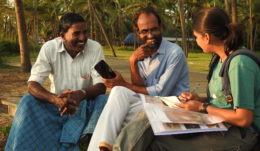
We have had our first training session over Skype with Daniela Rusowsky (www.funkproductions.wordpress.com) who is teaching all of us how to use a camcorder effectively in order to produce a series of infomercial films targeted at various audiences (kids, teenagers, organizations and for the international community). We have all had a bit of practice with the camera now and are having a good laugh filming each other, will let you know how this progresses. A series of PowerPoint presentations have also now been created for the educational department at the national zoo which is a great opportunity to let more people, particularly young people, know about these remarkable mammals.

The number of individuals and organisations which are showing an interest on the work we are carrying out is growing steadily. We are really keen to get as many of these to participate actively. It will be an ongoing process since they will be crucial in order to create a sustainable long term project. Particular thanks has got to go to ecological foundation of Punta Cana for allowing us access to their land as well as covering the cost of our food and lodging while working there. We have also had support from The Nature Conservancy and the National Geological Survey in the form of GIS layers (basically different types of electronic maps). These maps have already proven really helpful in planning our research and will be crucial later on in the project in order to analyse our results and come up with some management and monitoring suggestions.

Unfortunately I’m stuck in the office for the time being doing essential administrative stuff that I have been putting off. I’ll miss not being out there with our great team for the next week or so but the need not to stay out of the forest for too long will urge me on to get the less exciting but just as essential work out of the way. Right, I’ll hand you over to Pedro…
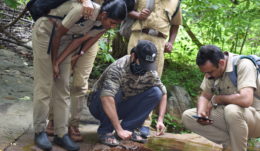
PEDRO MARTINEZ: On February 1st 2010, I officially joined the project “The Last Survivors“. Right away, we headed out to pick up Nicolas and LLeyo, the other two members of the field team. During our first night, we took a walk into the forest looking for some solenodon and hutia in order to collect tissue samples for genetic analysis. Thirty minutes later, LLeyo emerged with a solenodon in his hands. Amazing! The following day, we set up camp up at Pelempito (an area in the south west of the country inside Sierra de Bahoruco National Park) from where we started the field work.

A few days later, we moved to Fundacion Punta Cana in the East of the country where we found good evidence of both hutia and solenodon. From Punta Cana we returned to Santo Domingo for some office work, and to plan the next steps of field work. Having generated a series of the random points following the elevation gradient (from about 400m to over 2000m) within Bahoruco we headed back out to the field. Three days of heavy rain almost ended our expedition; however, we got lucky on the fourth day when a sudden change in the weather made all of us feel a lot better.

After three days of work in Pelempito we moved to a place known as cabin number two which is an old disused sawmill, one of the many distributed across the country, previously used for cutting down thousand of pines for timber. According to Nicolas, who by the way is a great story teller, it was here where a dog killed five solenodon in one night. According to old park guards, solenodon use to be common here and even use to scavenge near the cabin. Sadly, this is no longer the case.

So far, this last phase of the work has been the most demanding one, basically due to the steep slopes and the difficulty of getting into and out of some sites, particularly the ones in the tangling cloud forest. However it was definitely worth while. To our surprise, we found evidence of both hutia and solenodon in some parts of the upper Cordillera. The evidence suggests that they mainly occur in areas where broadleaf patches were relatively close by. We initially planned to go to one site a day but moral was high amongst the group and almost everyday we managed two sites.

We also had the chance to verify the story that Nicolas’ son, Yimell (an aspiring young biologist who came along with us), had told. He claimed that he had seen hutia dung in a mangrove area near the town of Pedernales (very close to the border with Haiti). At first there was a certain sense of disbelief about it, so, on our way back to Santo Domingo we stopped by the mangrove area and found clear signs of the presence of hutia, it was unbelievable.
Finally, the team this time will split in two. I will be working with Nicolas and LLeyo back in the area around cabin two and Joe will stay at the office finishing necessary reports. We will miss you man!!!!