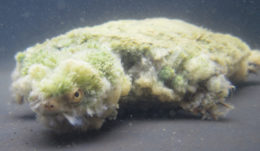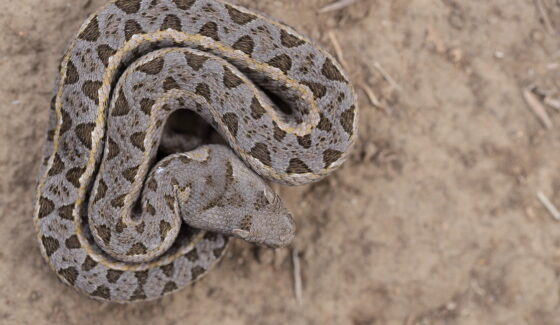
The Purple frog (Nasikabatrachus sahyadrensis) is a flagship species for conservation in India. Its distribution is restricted to two states in peninsular India, Kerala and Tamil Nadu. It has been reported only from a few localities. According to available information about its range of distribution and potential threat it has been categorized as ‘Endangered’ in IUCN red list.

The life style of purple frog is most interesting and fascinating. It is very challenging to study and understand from a scientific point of view. I have been working on this fascinating animal for the last two years as part of my PhD program supported by EDGE fellowship. My study aims to collect information about various aspects of this frog’s life focusing mainly on breeding behavior and tadpole development. Such a study will help not only in understanding the biology of the frog but will also help in understanding the potential threats faced by this species during various stages in its life.

Purple frog is secretive and hence its study is challenging. More often than not, these frogs are found very near to seasonal streams. These streams begin to flow with the onset of monsoon in the month of May till September - October after which they dry up until the next monsoon season. The frog’s life is mostly spent under the ground and it comes out only during the monsoon for breeding. During the breeding season, the males can be heard calling from below the ground around these streams. These streams seem to be important places for purple frog to breed.

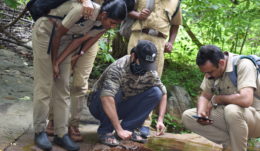
During our study we found that most of the localities where purple frog is found, are heavily disturbed by human activities. Many plantation areas in purple frog’s home are recent ones (maximum 50 to 70 years old) adjacent to forest. Road construction through these places is also a major concern for the frog. In search of ideal habitat for breeding or other needs it may have to cross the roads, which can be dangerous. Many locals have reported a number of amphibian road kills including those involving Purple Frog.

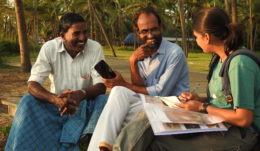
During my field trip this year, which starts in May 2010, I will be interacting more with the locals and tribal who are living within the habitat of purple frog to find out more about their interactions with the frog and their behavior towards it. My focus is to educate them about the importance of amphibian conservation with special emphasis on Purple frog. It is high time that effective actions are taken both at small and large scale, for conserving the habitat of Nasikabatrachus before tea gardens completely replace forests of the Western Ghats and our dear frog is left without place to survive.
EDGE needs support to continue conservation projects like this - if you can help please donate here.
The maned three-toed sloth (Bradypus torquatus) is EDGE mammal conservation priority number 63, and is also today’s IUCN Species of the Day.

Named after its long mane of black hair, which runs down the back of the neck and over the shoulders, the maned three-toed sloth is an incredible mammal which spends most of its life in the branches of trees, either hanging upside down or sitting in a fork. It is so well adapted to its upside-down lifestyle that even its fur grows in the opposite direction to that of most mammals!

These sloths don’t have any biting teeth, so instead they rip their leaf-food with their lips. Their slow lifestyle and poor food mean that sloths have a slow metabolic rate - about half that of most mammals - and they sleep for around 15 hours a day! Because of this, they visit the toilet infrequently, about once or twice a week, one of the few reasons why a sloth will come down from the tree-tops to the ground.

There was once a hundred species of sloth roaming the Earth, including giant land sloths and even aquatic sloths in Peru (you might not believe it, but living sloths are actually not bad at swimming either!)
Most sloth species went extinct about 10,000 years ago when prehistoric humans arrived in the Americas. Now only five species of sloth remain, all of which live in the tree-tops; their incredible evolutionary path means that their closest relatives - the anteaters - look and behave completely differently.

The maned sloth is the most threatened sloth species, because it is only found in the Atlantic coastal rainforest of Brazil; this habitat covers a small area, is disturbed and fragmented, and is getting rapidly smaller as a result of logging, charcoal production, and clearance for plantations and cattle pasture. The large gaps in the forest mean that some populations may already be extremely small. Today, the Atlantic forest is reduced to less than 10% of its original area, and this region has the highest human population in Brazil so the pressure on the forest is high.

The EDGE of Existence programme is working to conserve the world’s most remarkable threatened species . To support our efforts, please donate here.
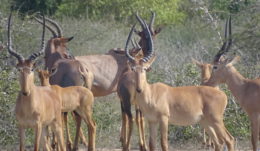
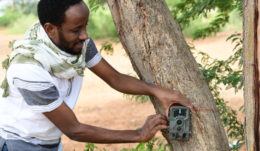
It has been long since updates are sent for the blog readers. All is well for hirola monitoring. A population is thought to increase if new born are added to the population; since December 2009, several calves of hirola have been sighted. In each group, at least one calf.

Something to be noted, all sighted hirola have good body condition charged from their coat and body stamina. Their hair is smooth and glittering – no standing hair recorded. Their muzzle is normal wet. Only one 4 months calve have been sighted limping for the last two months. The injury is in the right hind limb. A small swelling is on the knee. However, the calf is in good body condition and can run but straining.


On the other side, the digestive system parasites study is still going on. Mugendi (a graduate student from Moi University) accompanied me to collect the hirola and livestock droppings.


Preliminary results from previous samples tested 80% positive of presence of gastro-intestinal parasites. Also livestock samples showed almost the same percentage. This shows that hirola might be facing the complications related to parasite infestations. Their adaptability and survival would be compromised.
Keep in touch for more updates!

In spite of these calf sightings, the long-term future of the hirola is not guaranteed and this species remains critically endangered with extinction.
To help support conservation work for the hirola - Africa’s most threatened antelope - please donate here.
Firstly, I’d like to tell Big Hello to dear blog readers.
Today I want to interest you my impression in Cambridge. I was very glad for participating in the international Student Conference on Conservation Science (SCCS) in Cambridge, which is best known as the home of the University of Cambridge, one of the world’s premier universities.

When look at from outside, almost all building was being looked at very old, with fantastic architecture. But as soon as go to inside, the interior design was very modern with high technology. There is everything that you need to learn very well.

The Conference was organized by department of zoology in St Catherine’s college. St Catharine’s College was founded in 1473 by Robert Woodlark and is situated in the centre of Cambridge. In the sixteenth century undergraduates were admitted. It was largely rebuilt in the 17th century but in 1965 there was further major rebuilding.

There are lot of bikes in all streets. Some bike looks like stayed long time and didn’t use. In my opinion bikes is very important effort for avoiding air pollution and useful for human health too.

I participated to present poster about impacts of illegal gold mining on gobi desert small mammal in Southern Mongolia. Today everyone knows that we must protect wild nature and is very important for our Earth. But circumstance is very different in real life.
About 15 years ago everyone in south part of Mongolia didn’t know about gold mining and doesn’t want to dig on surface. If they dig, they thought the sky (Mongolian god) will be angry. From 90’s Mongolian political system changed from socialistic rule to free market economic. Hence, those social economic rapid changes began to influence on Mongolian wildlife negatively. Those changes didn’t pass Gobi desert wildlife, which is a large desert region in Asia. One of the most serious impacts in Gobi desert is illegal gold mining. Hence, I decided to participate about illegal gold mining in Conference. Many people were interested my poster, especially in the feral species effects and the long eared jerboa.

During conference, I liked the hall that was equipped very well, such as projector, computer, speakers and etc. There are few such hall in Mongolia.

By participating this conference, I increased my knowledge about deforestation, CBD, conservation acts and knew about some organization, such as UNEP WCMC, ARCADIA, Cambridge Conservation Initiative and so on.

Also I obtained good knowledge and newish idea about climate change, presentation slide design and modern conservation approach. Presentations was very great and useful.

During conference I made many friends who work and study in famous institute, project and university around the world. That friendship will help me through sharing knowledge and information. Also we shared culture and tradition of each other’s country.

The student conference didn’t organized only posters and presentations. There were nine workshops, such as Practical Conservation Genetics, Planning a conservation research programme, Use of evidence-based conservation, Raising funds for your conservation project , An introduction to systematic conservation planning, How to write a scientific paper, or How to avoid Snoopy’s problem…, Communicating your science: beyond peer-reviewed papers and Making conservation relevant: communicating with policy makers.
Everyone had to select 2 workshops. I selected Raising funds for your conservation project and How to write a scientific paper, or How to avoid Snoopy’s problem…. Dr, Rosie Trevelyan, Tropical Biology Association, Department of Zoology, University of Cambridge, taught us about how to write a grant proposal efficiently and successfully. She said that “Getting money for your project need be a matter of being in the right place at the right time”.

Also Dr Martin Fisher, Editor of Oryx, Fauna & Flora International, taught us about writing a scientific paper. He said: “Would you like this to be you? Are you determined that your first scientific paper will be rejected (so many are!)? Attend this workshop to find out how to ensure that this happens… or perhaps even how to avoid it. Common pitfalls, glaringly obvious errors, verbosity - all these and more easy strategies to ensure that you receive your first rejection slip will be covered in painful detail…It’s the final year of your PhD, you’ve finally gathered some data, and you are going to be famous… well, at least you plan to write your first scientific paper… Do yourself a favour, do the Editor a favour, attend this workshop!”

Also staffs of zoological museum received us with wine in museum. There are many wonderful collections in museum.
And we had little party which was organized every student conference. It was very funny and happy.

Finally, I am thankful to SCCS for participating me. I gratefully acknowledge not only the support of the EDGE programme, but also the help and advice of SFP and NUM teachers. Thanks again.
One of the few remaining Javan rhinos was killed by poachers in Vietnam last month, it has been revealed; with fewer than 60 individuals remaining the Javan rhino (Rhinoceros sondaicus) is the rarest of the five rhino species.

The dead rhino was found on April 29th, shot with its horn missing. This represents a massive loss for the Vietnamese sub-population, which is thought to number fewer than 8 rhinos. The Javan rhino is legally protected in Vietnam, but as horns are valued for use in traditional medicine poaching remains a threat.

In the past extensive habitat loss across Asia and poaching drove the global population to its current critical level, and now the population is so small the Javan rhino is extremely vulnerable to disease, natural disasters and problems caused by inbreeding.

The Javan rhino is Critically Endangered and is ranked the 11th most important mammal conservation priority worldwide, according to the EDGE method. This species is thought to have remained relatively unchanged for over one million years, and is one of the few surviving members of an ancient and formerly diverse group of ungulates (hoofed animals), along with tapirs and wild horses.

Formerly widespread in south-east Asia, this rhino is now confined to two widely separate locations; the Ujung Kulon National Park in Java, and a small population at the Cat Tien National Park in Vietnam, where this shooting took place.
To support conservation efforts for the world’s most remarkable threatened species, please donate here.