Now that it is winter and the long-eared jerboas are hibernating, our jerboa EDGE Fellow, Uuganbadrakh is concentrating on studying for his Master’s exams at the National University of Mongolia. He recently sent us this account of his daily life in Mongolia.
My house is on the city edge and I take 40 minutes by microbus or an hour by bus between my house and school or my work place at the Steppe Forward Program.
When I go by bus, it is cheap, but takes a long time as there is normally a long wait at the bus station and on the bus. Especially, to go by bus in winter is very difficult.
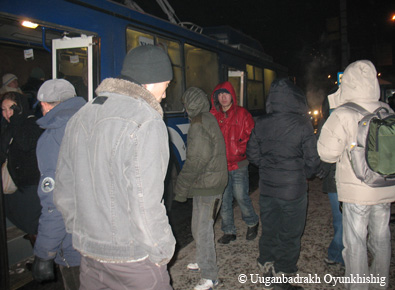
Due to traffic jams and overloading, people are waiting for a long time at bus stations.
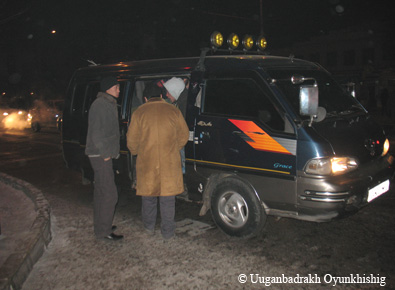
Mongolian general transportation-the microbus
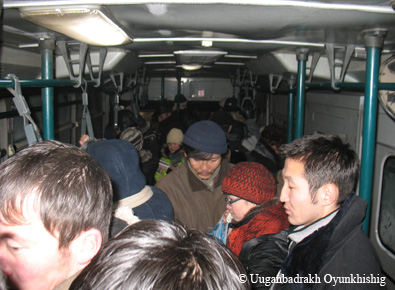
The bus is often standing room only
Sometimes to go home during traffic jam I spend a very long time in the bus. But when I go by microbus, being a person with low income like me it is difficult. But sometime when I am late to go home, I go by microbus. I hardly never use a taxi- I only go by taxi to collect field study things in spring.
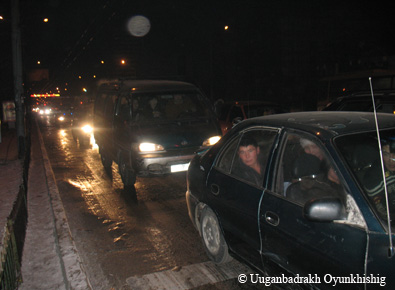
Traffic jams often occur in Ulaanbaatar city, increasing air pollution.
I study on my master lessons 8 hours every week and my favorite lesson is statistics because I am an ecology and conservation biologist. If person who work in this field make a scientific study and doesn’t know general statistic concept, he can’t do good research. Therefore I participate in this lesson actively. Now I am learning MINITAB 13, JMP IN 5.1 programs for statistics analysis and EstimateS 8.0 program for species diversity measures.
I am thinking, this summer I will learn MARK 4.3 and the arcGIS 9.0 program- both are very important programs for my research. As for my work, I do this according to my project plan. However to do my work, we have a problem which is that my room is colder than other rooms. Therefore if we sit up long time, we begin cold and to this occasion we play table tennis.
In my work the most important thing is language knowledge because I use English in my every work. Therefore to improve my English skills I am involved in an English training center by EDGE program support. Every week I study 10 hours English on training center and as much as possible I try to do my English homework. But when I have much work, I can’t do it. On week which has lot of work that is master and language training center I do it in the office at the weekend.
I have a lunch on university food place that have lunch and breakfast. It is different from restaurant as restaurants are high level serving places in Mongolia. It is more like fast food place in USA and European countries.
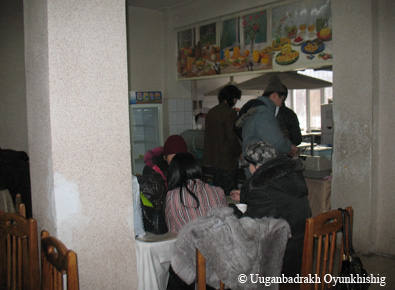
Foods that you can buy on university food place are cheap. Students usually eat khuushuur and piroshki.
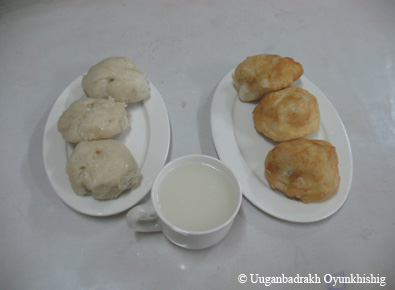
It is cut meat that covered by flour and boiled fat which used many times. So it affects at digestive tract system negatively. So when I eat at university food place and I try to don’t eat it.
I come back by microbus or bus at 8 o’clock in the evening after finish all my work. I live at home with a relative and he usually isn’t at home. When I come back, nobody usually be my home and my home is very cold because it is with balcony. I rent one room of a three-room flat and my flat owner rent to people all rooms, I live with a total of 13 people between the 3 rooms. Sometimes it is very difficult. But it is common in Mongolia.
Countryside students usually live in the dormitory of university and city students live at home. Since I enter university in 2002, I have lived in a Mongolian ger (a traditional tent-like Mongolian dwelling), dormitory, flat, and with relatives and friends. Many students are living like me. To find job with high salary and condition in Mongolia, I should learn English and professional knowledge well. So if I can learn foreign languages, I will learn English well and modern scientific knowledge. Most Mongolian students want to learn and live high developed countries. But I want to live in my native country and finish my masters. You can see how most Mongolian student live from this blog. My country is developing country and young people’s life is not good. But we should fight with all our strength and chance to develop our country.
The main message I hope to give is to conserve wildlife, young people should learn high knowledge at any condition. Young age is the most powerful age of human life.
Uuganbadrakh is planning to return to the Gobi Desert to continue his work monitoring the long-eared jerboa in a few months time. You can support his field work by donating to the EDGE Fellows programme.