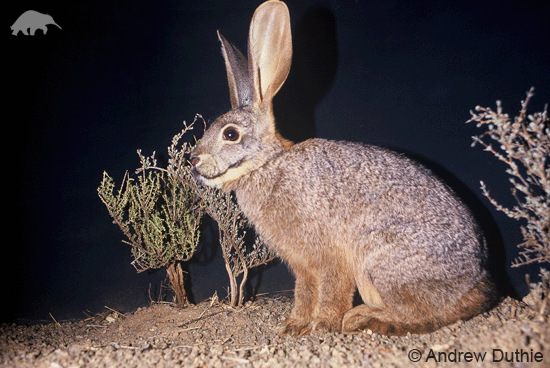
Lagomorphs are a very distinct group of small mammalian herbivores. The order Lagomorpha (pikas, rabbits, hares and jackrabbits) is defined by small peg-like teeth immediately behind the incisors, found in all species but in no other mammals. There are 87 species of living Lagomorphs and they thrive in a wide variety of habitats. Nonetheless, a quarter of these species are threatened with extinction. Despite their charismatic appearance and interesting biology, a number of Lagomorph species are among the rarest and most endangered of all mammals: one in four species are internationally listed as threatened. This puts a disproportionate amount of unique evolutionary history at risk because most genera of Lagomorph are small (<2 species), meaning that the extinction of these genera would leave no similar species anywhere else. In fact: three species of rabbit are featured in the Top 100 EDGE Mammals list that highlights unique species in urgent need of conservation attention. A recent study by a team of Mexican researchers highlights the state of knowledge and conservation of all globally endangered Lagomorphs. This synthesis provides important data on the conservation measures and research that are required to preserve EDGE species.
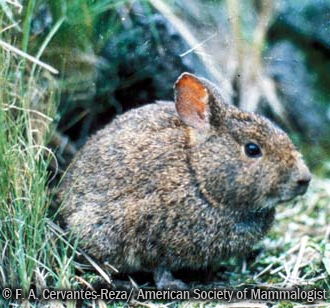
The three EDGE species in the order are all members of the Leporidae family, which includes rabbits, hares and jackrabbits. They have short, furry tails and elongated ears and hind legs. At number 10 in the EDGE mammals list, the Riverine rabbit (Bunolagus monticularis) currently lives in an area < 500 km2. Preserving and restoring the riparian habitat needed for its survival is critical, as well as further research into its ecology and population genetics, as no data has been published in the past five years. The tiny volcano rabbit (Romerolagus diazi) sits at number 40 in the EDGE ranking. Its distribution is restricted to volcanic slopes near Mexico City, only a 45 minute drive away from a metropolis of 17 million people. This puts it under pressure from habitat degradation, tourism and hunting. Appropriate management of the forests and bunchgrass slopes where the volcano rabbit lives needs to be combined with education and outreach actions to curb illegal hunting. The Amami rabbit (Pentalagus furnessi) is ranked 42 in the Top 100 EDGE mammals. Pentalagus is the only black rabbit and it shares more characteristics with fossil species from the Miocene period than any other living Lagomorph. Found only on two small islands in the Ryuku archipelago of south Japan, it is threatened by multiple interacting threats including habitat clearing and feral or introduced predators. Preserving and restoring the dense forests Amami rabbits inhabit (another unusual feature for a rabbit) needs to be implemented in conjunction with predator management to ensure its survival.
Another recent study investigated why some genera are much less diverse than others, and what puts them at risk of extinction. Understanding the origins of diversity can guide us in preserving it. The team of researchers from The University of Queensland and Queen’s University Belfast, led by Dr. Luis Verde Arregoitia, found that threatened species within this order tend to occur in areas where human population densities are high, and that species which occupy many different environments – including converted habitats – are less likely to be threatened. Current human pressures are so strong that they override any variation in ecology, evolution, and geography for living species.
This study also points out that the three Evolutionarily Distinct and Globally Endangered Lagomorphs (the riverine rabbit Bunolagus monticularis, the volcano rabbit Romerolagus diazi and the Amami rabbit Pentalgus furnessi) are paleoendemics: systematically isolated taxa whose distributions represent the remnants of originally larger geographic ranges that have been reduced due to environmental changes. These lineages have low rates of diversification (the evolutionary process by which new species arise) that mostly likely relate to their environment and biological traits. Evolutionarily distinct species have no close relatives and thus represent a greater proportion of independent evolutionary time on the Tree of Life.