About
Ctenella chagius (Chagos brain coral) may be the world’s most endangered coral lineage. A monotypic genus, it is a member of the Euphylliidae family and is found exclusively in the Chagos Archipelago Strict No-Take Marine Protected Area in the Central Indian Ocean. Its habitat has been historically protected from direct anthropogenic impacts such as overfishing and other destructive activities; however, reefs within the region have been subject to recent mass bleaching events with high subsequent mortality and loss of habitat. A relict population scattered widely throughout the Archipelago continues to survive.
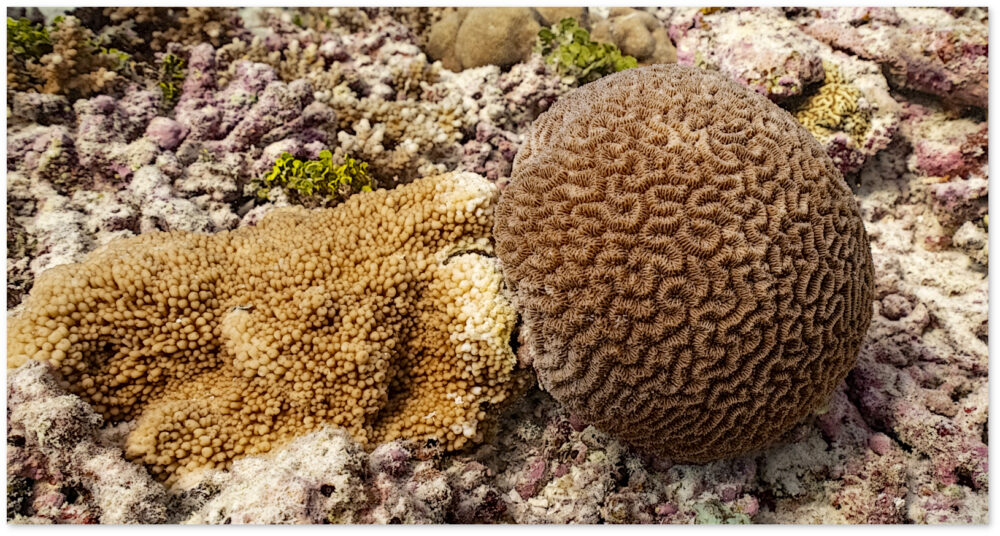
Ctenella chagius grows in large (up to 1m) hemi-spherical colonies which may be cream, green or dark brown in colour; however, surveys over the last decade have not recorded any extant large colonies (>50cm), likely due to recent mortality events.
A live broodstock population (comprising twelve individuals from two sites) was recovered to the UK in 2023, and is currently being maintained in aquaria at the Zoological Society of London and Horniman Museum and Gardens, as part of an ongoing conservation action plan. C. chagius was the first coral species to be simultaneously assessed by both the IUCN Red and Green List Assessments, and was recently uplisted to Critically Endangered (CR).
In early 2024, the Horniman Museum and Gardens successfully bred the species in captivity.
- Order: Scleractinia
- Family: Euphyllidae
- Trend: decreasing
- Colony Size: up to 1m
- Depth Range (m): 3 - 45
Distribution
Ctenella chagius is found exclusively in the Chagos Archipelago in the Central Indian Ocean.
Habitat and Ecology
This species can be found on reef slopes and in lagoons at depths ranging between 3 and 45m.
Ctenella chagius has also shown an aggressive ability known as extracoelenteric digestion where a coral is able to extend its stomach in digestive filaments onto the living tissue of an adjacent coral and destroy it (see image). This provides Ctenella with an important ecological advantage in a fiercely competitive struggle for light and space in reef ecosystems.