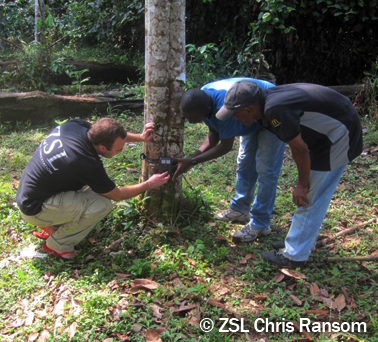
Thank you for identifying that this photograph should be removed, as it doesn't contain any animals.
African wild dog (lycaon pictus)
Endangered (IUCN Red List):
EX
EW
CR
EN
VU
NT
LC
The engangered African Wild Dog appears similar in size to that of a large domestic dog and is a rare Instant WILD sighting. Standing at about 75 centimetres tall, its head and body length average about 100 centimetres. Its fur is often a mix of oranges, blacks, whites and greys hence why it is also referred to as the painted dog.
Black rhinoceros (diceros bicornis)
Critically Endangered (IUCN Red List):
EX
EW
CR
EN
VU
NT
LC
The critically endangered Black Rhinoceros has thick, layered skin. It is distinguish by two horns, the larger front horn typically 50 cm (20 in) long. Skin color depends on local soil conditions and the rhinoceros' wallowing behavior, so many black rhinos are typically not truly black in color. Learn more about this EDGE species.
Lion (panthera leo)
Vulnerable (IUCN Red List):
EX
EW
CR
EN
VU
NT
LC
The lion is the second-largest living cat after the tiger. Lion coloration varies from light buff to yellowish, reddish, or dark ochraceous brown. The underparts are generally lighter and the tail tuft is black. The mane of the adult male lion, unique among cats, is one of the most distinctive characteristics of the species.
Giraffe (giraffa camelopardalis)
Least Concern (IUCN Red List):
EX
EW
CR
EN
VU
NT
LC
Giraffes are easily identified by their height, with males reaching up to 5.5 metres (18 ft) at the horn tips. Females are between 4 and 4.5 metres. The coat is made up of brown blotches or patches separated by lighter hair. Each giraffe has a unique coat pattern. Both sexes have prominent horns.
Leopard (panthera pardus)
Near Threatened (IUCN Red List):
EX
EW
CR
EN
VU
NT
LC
The leopard has relatively short legs and a long body with a large skull. Its fur is marked with black rosettes in a distinctive pattern. Fur under the underbelly tends to be lighter colored and of a softer, downy type. Solid black spots in place of open rosettes are generally seen along the face and limbs.
African elephant (loxodonta africana)
Vulnerable (IUCN Red List):
EX
EW
CR
EN
VU
NT
LC
The African elephant is the largest living terrestrial animal. Its thickset body rests on stocky legs and it has a concave back. Its upper lip and nose forms a trunk. The trunk acts as a fifth limb, a sound amplifier and an important method of touch. Unlike Asian elephants, both male and female African elephants have tusks.
Greater kudu (tragelaphus strepsiceros)
Least Concern (IUCN Red List):
EX
EW
CR
EN
VU
NT
LC
Greater kudus have a narrow body with long legs. Their coats can range from brown/bluish-grey to reddish-brown. They possess between 4–12 vertical white stripes along their torso. The head tends to be darker in colour than the rest of the body and exhibits a small white chevron which runs between the eyes.
Black backed jackal (canis mesomelas)
Least Concern (IUCN Red List):
EX
EW
CR
EN
VU
NT
LC
Black-backed jackals are small, foxlike canids which measure 38–48 cm in shoulder height and 68-74.5 cm in length. The general colour is reddish brown to tan, while the flanks and legs are redder. The back is intermixed with silver and black hairs, while the underparts are white. Their tails have a black tip, unlike side-striped jackals which have white tipped tails.
Striped hyena (hyaena hyaena)
Near Threatened (IUCN Red List):
EX
EW
CR
EN
VU
NT
LC
A nocturnal animal, the striped hyena typically only makes itself visible in complete darkness, and is quick to return to its lair before sunrise. The striped hyena has a bulky body, but short torso. The neck is thick, long and largely immobile. In winter, the coat is usually of a dirty-brownish grey or dirty gray colour.
Thank you for identifying that this photograph should be removed, as it doesn't contain any animals.
European otter (lutra lutra)
Near Threatened (IUCN Red List):
EX
EW
CR
EN
VU
NT
LC
The European Otter tends to live in bodies of freshwater. They have a brown coat, with white features along the length of it. White extends under the face and down to the belly. You will notice that these white markings are different on each of them.
Important Sighting: Their numbers are thought to be in decline.
European water vole (arvicola amphibius)
Least Concern (IUCN Red List):
EX
EW
CR
EN
VU
NT
LC
The European Water Vole is a semi-aquatic rodent. Water voles have rounder noses than rats, deep brown fur, chubby faces and short fuzzy ears; unlike rats their tails, paws and ears are covered with hair.
Important Sighting: Their numbers are thought to be in decline.
European hedgehog (erinaceus europaeus)
Least Concern (IUCN Red List):
EX
EW
CR
EN
VU
NT
LC
Also called the Common Hedgehog, they grow to about 20 to 30 cm in length. Males tend to be slightly longer and heavier than females. Brown / light brown hair with a back of short spines with a black pointy nose.
European red fox (vulpes vulpes)
Least Concern (IUCN Red List):
EX
EW
CR
EN
VU
NT
LC
Foxes are small to medium-sized canids (slightly smaller than the median-sized domestic dog), characterized by possessing a long narrow snout, and a bushy tail (or brush). In the wild, foxes can live for up to 10 years, but most foxes only live for 2 to 3 years due to hunting, road accidents and diseases.
European badger (meles meles)
Least Concern (IUCN Red List):
EX
EW
CR
EN
VU
NT
LC
What to look for: The European badger is a social burrowing animal which lives on a wide variety of plant and animal food. Look for black and white patterns of fur on their snouts - short feet, with five toes on each foot and ears tipped with white.
European polecat (mustela putorius)
Least Concern (IUCN Red List):
EX
EW
CR
EN
VU
NT
LC
It is of a generally dark brown colour, with a pale underbelly and a dark mask across the face. The ears are dark brown and edged with white. The limbs are pure black or black with brown tints, while the tail is black or blackish-brown, completely lacking light underfur.
European hare (lepus europaeus)
Least Concern (IUCN Red List):
EX
EW
CR
EN
VU
NT
LC
The European hare has elongated ears which in this species ranges from 94–102 mm from the notch. Its body length ranges from 600mm - 750 mm with a tail length of 72–110 mm. Most of the hare's body is covered in yellowish-brown to greyish-brown fur but has greyish-white fur on the underside.
Bennett's wallaby (m. r. rufogriseus)
Least Concern (IUCN Red List):
EX
EW
CR
EN
VU
NT
LC
Not indigenous to the United Kingdom, but can be spotted on this Instant Wild camera. Can grow up to 6 feet in length (from head to tail) and has strong powerful hind legs. Wallabys have powerful tails used for balancing and their fur appears brown / beige / grey in colour.
Asian elephant (elephas maximus)
Endangered (IUCN Red List):
EX
EW
CR
EN
VU
NT
LC
Not indigenous to the United Kingdom, but can be spotted on this Instant Wild camera. An Asian bull elephant (male) may weigh an average of 5,260 kg and are typically 2.75 m high at the shoulder. Skin color is usually gray / brown in appearance. Asian elephants are smaller than their African savannah relatives.
Thank you for identifying that this photograph should be removed, as it doesn't contain any animals.
Mountain mouse deer
(IUCN Red List):
EX
EW
CR
EN
VU
NT
LC
In June 2005, Colin Groves published a paper in The Raffles Bulletin of Zoology that distinguished three species of Mouse-deer from Sri Lanka and India. Colin also stated that ‘a single skull" was found, representing a possible fourth species’. The ‘Mountain Mouse-deer’ had only been photographed once 3 years ago until spotted by Instant Wild.
Grizzled giant squirrel (ratufa macroura)
Near Threatened (IUCN Red List):
EX
EW
CR
EN
VU
NT
LC
The grizzled giant squirrel’s common name came from the grey to brown colouration highlighted with white at the top of the tail, giving it a grizzled appearance. The rest of the body varies in colour geographically and may be brown, red, grey or black, but the fur on the underside is always lighter than the back. This species is probably in significant decline.
Sri Lankan leopard (panthera pardus kotiya)
Endangered (IUCN Red List):
EX
EW
CR
EN
VU
NT
LC
The Sri Lankan leopard has a tawny or rusty yellow coat with dark spots and close-set rosettes, which are smaller than in Indian leopards. It has an elongated body supported on relatively stocky legs and broad paws. The survival of the Sri Lankan leopard is threatened due to poaching, habitat loss, and persecution.
Asian palm civet (paradoxurus hermaphroditus)
Least Concern (IUCN Red List):
EX
EW
CR
EN
VU
NT
LC
The Asian palm civet is a small, mottled gray and black viverrid weighing 2 to 5 kg (4.4 to 11 lb). It has a body length of about 53 cm (21 in) with a 48 cm (19 in) long tail. Its long, stocky body is covered with coarse, shaggy hair that is usually greyish in color.
Black naped hare (lepus nigricollis)
Least Concern (IUCN Red List):
EX
EW
CR
EN
VU
NT
LC
The black-naped hare is also known as the Indian hare. It measures about 40-50 cm and has a grayish-white coat with a blackish patch on the nape and a short grayish tail. The under parts are mottled white.
Golden palm civet (paradoxurus zeylonensis)
Vulnerable (IUCN Red List):
EX
EW
CR
EN
VU
NT
LC
The golden palm civet is a civet endemic to Sri Lanka. It is a smallish civet and has a coat that is a golden brown or dark brown in color. The hair on the back of its neck grows reverse grain, from the shoulders toward the head. The golden palm civet is nocturnal as well as solitary.
Toque macaque (macaca sinica)
Endangered (IUCN Red List):
EX
EW
CR
EN
VU
NT
LC
The toque macaque is endemic to Sri Lanka and is an endangered species. Threats to this species include habitat loss, owing to the encroachment of plantations and fuel wood collection and other threats such as shooting, snaring and poisoning. They are considered to be crop pests.
Junglefowl (gallus lafayetii)
Least Concern (IUCN Red List):
EX
EW
CR
EN
VU
NT
LC
As with other junglefowl, the Sri Lankan junglefowl is strongly sexually dimorphic: the male is much larger than the female, with more vivid plumage and a highly exaggerated wattle and comb. The feathers of the mane descending from head to base of spine are golden, and the face has bare red skin and wattles. The comb is red with a yellow centre.
Wild boar (sus scrofa)
Least Concern (IUCN Red List):
EX
EW
CR
EN
VU
NT
LC
The body of the wild boar is compact; the head is large, the legs relatively short. The fur consists of stiff bristles and usually finer fur. The colour usually varies from dark grey to black or brown, but there are great regional differences in colour. During winter the fur is much denser.
Thank you for identifying that this photograph should be removed, as it doesn't contain any animals.
Eurasian lynx (lynx lynx)
Least Concern (IUCN Red List):
EX
EW
CR
EN
VU
NT
LC
The Eurasian lynx (Lynx lynx) is a medium-sized cat native to European and Siberian forests, South Asia and East Asia.Ranges in length from 80 to 130 cm (31 to 51 in) and stands about 70 cm (28 in) at the shoulder. Ranges in length from 80 to 130 cm (31 to 51 in) and stands about 70 cm (28 in) at the shoulder.
Eurasian brown bear (ursus arctos arctos)
Least Concern (IUCN Red List):
EX
EW
CR
EN
VU
NT
LC
The Eurasian brown bear has brown fur, which can range from yellow-brownish to dark brown, red brown, and almost black in some cases; albinism has also been recorded.[2] The fur is dense to varying degree and the hair can grow up to 10 cm in length. Their weight varies depending on habitat and time of the year.
Przewalski's horse (equus ferus przewalskii)
Critically Endangered (IUCN Red List):
EX
EW
CR
EN
VU
NT
LC
Przewalski's horse is a rare and endangered subspecies of wild horse (Equus ferus) native to the steppes of central Asia, specifically China and Mongolia. At one time extinct in the wild, it has been reintroduced to its native habitat in Mongolia. The coat is generally tan in color, varying from dark brown around the mane to pale brown on the flanks.
Siberian roe deer (capreolus pygargus)
Least Concern (IUCN Red List):
EX
EW
CR
EN
VU
NT
LC
Capreolus pygargus, also known as the Siberian roe deer or eastern roe deer, is a species of roe deer found in northeastern Asia. Roe deer can jump up to 10 metres and generally live about 8–12 years, with a maximum of about 14–18 years. They display a reddish brown cost in summer months and a grey, pale brown / grey coat in the winter
Pallas cat (otocolobus manul )
Near Threatened (IUCN Red List):
EX
EW
CR
EN
VU
NT
LC
Pallas's cat is about the size of a domestic cat, with a 46 to 65 centimetres (18 to 26 in) long body and a 21 to 31 centimetres (8.3 to 12 in) long tail. It weighs 2.5 to 4.5 kilograms (5.5 to 9.9 lb). The combination of its stocky posture and long, dense fur makes it appear stout and plushy. There are clear black rings on the tail and dark spots on the forehead.
Wolverine gulo. gulo
Least Concern (IUCN Red List):
EX
EW
CR
EN
VU
NT
LC
The wolverine is a stocky and muscular animal with short legs, broad and rounded head and small eyes with short rounded ears. It resembles a bear more than other mustelids. Its legs are short, while its large five-toed paws and plantigrade posture facilitate movement through deep snow. Wolverines have thick, brown / dark brown fur.
Siberian ibex (capra sibirica)
Least Concern (IUCN Red List):
EX
EW
CR
EN
VU
NT
LC
Individual sizes vary greatly, from heights between 67–110 centimetres (26–43 in) and weights between 35–130 kilograms (77–290 lb). Typical colouration is a light tan; mature males becoming much darker with white patches. Both sexes have beards and horns.
Gray Marmot (marmota baibacina)
Least Concern (IUCN Red List):
EX
EW
CR
EN
VU
NT
LC
The Gray Marmot occupies only tips of ridges characterized by alpine vegetation, whilst the Siberian Marmot inhabits productive highland valleys. This species, like most marmots, is highly social, and lives in colonies with many burrows. Enemies include large raptors, wolves and other smaller predators such as foxes, steppe polecats, and Pallas’ cats.
Wild boar (sus scrofa)
Least Concern (IUCN Red List):
EX
EW
CR
EN
VU
NT
LC
The body of the wild boar is compact; the head is large, the legs relatively short. The fur consists of stiff bristles and usually finer fur. The colour usually varies from dark grey to black or brown, but there are great regional differences in colour. During winter the fur is much denser.
Thank you for identifying that this photograph should be removed, as it doesn't contain any animals.
Malayan tapir (tapirus indicus)
Endangered (IUCN Red List):
EX
EW
CR
EN
VU
NT
LC
The Malayan tapir (Tapirus indicus), also called the Asian tapir, is the largest of the four species of tapir and the only one native to Asia. The animal is easily identified by its markings, most notably the split between white and black skin.
Important Sighting: Their numbers are thought to be in decline.
Sunda Pangolin (manis javanica)
Endangered (IUCN Red List):
EX
EW
CR
EN
VU
NT
LC
Pangolins or scaly anteaters are a group of unusual mammals with tough, protective keratin scales. Specialised for feeding on ants and termites, they occupy a niche equivalent to that of the American anteaters. The Sunda pangolin possesses long, powerful claws, for ripping open ant and termite nests, and a long, thin, sticky tongue which can measure up to 40 cm in length, for scooping up its prey.
Sumatran rhinoceros (d. sumatrensis)
Critically Endangered (IUCN Red List):
EX
EW
CR
EN
VU
NT
LC
This two-horned rhino is the smallest and most threatened of the five living rhinoceros species. It is sometimes referred to as the ‘hairy rhino’ because of the long coarse hair that covers its body. The species leads a solitary life deep in the rainforests of South East Asia, where it has survived virtually unchanged for a million years.
Important Sighting: Their numbers are thought to be in decline.
Sambar deer (rusa unicolor))
Vulnerable (IUCN Red List):
EX
EW
CR
EN
VU
NT
LC
The appearance and the size of sambar vary widely across their range. The shaggy coat can be anything from yellowish-brown to dark grey in colour and, while it is usually uniform in colour, some subspecies have chestnut marks on the rump and underparts. Sambar also have a small but dense mane, which tends to be more prominent in males. The tail is relatively long for deer, and is generally black above with a whitish underside.
Sumatran tiger (panthera tigris sumatrae)
Critically Endangered (IUCN Red List):
EX
EW
CR
EN
VU
NT
LC
The Sumatran tiger is the only surviving member of the Sunda Islands group of tigers that included the now extinct Bali tiger and Javan tiger. Their population is thought to number between 400 to 700 individuals. The Sumatran tiger has been described as darker in fur colour and as having thicker stripes than the Javan tiger.
Important Sighting: Their numbers are thought to be in decline.
Sumatran elephant (e. maximus sumatranus)
Critically Endangered (IUCN Red List):
EX
EW
CR
EN
VU
NT
LC
The Sumatran elephant (Elephas maximus sumatranus) is one of three recognized subspecies of the Asian elephant, and native to Sumatra island of Indonesia. In January 2011 the Sumatran elephant was classified as critically endangered by IUCN. It is estimated that over 83% of the Sumatran elephant's former habitat has now been lost to plantations.
Important Sighting: Their numbers are thought to be in decline.
Wild boar (sus scrofa)
Least Concern (IUCN Red List):
EX
EW
CR
EN
VU
NT
LC
The body of the wild boar is compact; the head is large, the legs relatively short. The fur consists of stiff bristles and usually finer fur. The colour usually varies from dark grey to black or brown, but there are great regional differences in colour. During winter the fur is much denser.
Sumatran ground cuckoo (c. viridis)
Critically Endangered (IUCN Red List):
EX
EW
CR
EN
VU
NT
LC
The Sumatran Ground Cuckoo is about 55 centimetres (22 in) long and is a long-tailed terrestrial species of cuckoo. It has green upper plumage with a black crown and a green bill. In 2006, a camera-trap surveying for tigers close to Kerinci Seblat National Park took an image of the Sumatran Ground Cuckoo - only the second time it had been recorded in the last ninety years. The current population is estimated at less than 250.
Important Sighting: Their numbers are thought to be in decline.
Dhole (cuon alpinus)
Endangered (IUCN Red List):
EX
EW
CR
EN
VU
NT
LC
The dhole, also called the Asiatic wild dog or Indian wild dog, is a species of canid native to South and Southeast Asia. It measures only two feet in length and stands 14 inches (360 mm) high at the shoulder. It has a pointed, black, fox-like muzzle with long, dark whiskers.
United Kingdom: Discover both native British and non-native species inside the perimeter of ZSL Whipsnade Zoo. We are particularly interested in spotting rarer British species such as the European hare. You may also be lucky enough to spot resident Asian elephants! Support this project
Kenya: ZSL is committed to understanding the conservation needs of wildlife in Kenya. Specifically, we are working with the Kenya Wildlife Service to increase the number of critically endangered black rhinos (an EDGE species) to 1,000 by 2020. Support this project, or learn more about EDGE mammals in Kenya.
Kenya:MWCT works with the Maasai community of Kuku Group Ranch, communally owned land in the Tsavo-Amboseli ecosystem, creating meaningful benefits from the sustainable management of their natural resources. Supporting these communities to live alongside wildlife on their land is critical for the ecosystem as a whole. Support this project
Sri Lanka: In 2009, after two hundred hours of surveying, ZSL EDGE researchers rediscovered the Horton Plains Slender loris - thought to be extinct. Our on going survey and reforestation project is working to create ecological corridors between fragmented forest patches to conserve vital habitat for this endangered species. Support this project
Mongolia: Mongolia’s deserts and steppes are home to Critically Endangered EDGE species such as the Bactrian camel and saiga antelope. ZSL helps train young conservationists in Mongolia to research and conserve the country’s unique, threatened species through ZSL EDGE and the Steppe Forward Programme. Support this project
Saudi Arabia: Since 1989 ZSL has managed breeding programmes for several species at the King Khalid Wildlife Research Centre (KKWRC) in Saudi Arabia. The KKWRC is responsible for successfully breeding and reintroducing many antelope species in several protected areas, such as the Ibex Reserve. The KKWRC also carries out the research into antelope population ecology, epidemiology and genetics that is necessary for effective conservation action. Support this project
Indonesia: Much of the ZSL Indonesia Field Programme's activities focus on the Sumatran tiger. Critically endangered and present nowhere else in the world, the Sumatran tiger is one of those species most vulnerable to the changes currently witnessed in Indonesia. Support this project
WHAT IS INSTANT WILD?Images of wild animals are sent to you directly from small automatic cameras placed in remote locations.
When you identify the wild animal by matching the photo with the relevant image in the Field Guide you save conservationist thousands of hours by helping to sort the images by species group. This enables scientist to analyze the data much faster and assess whether the threatened animals are increasing or decreasing. This knowledge is essential for effective conservation.
Get THE Instant WILD APPThe Instant Wild App provides you with the ability to view the latest captured images from camera traps around the world
Camera traps are a tool widely used in conservation work. They take a photo when a motion sensor detects movement within the field of view, and within a certain range. We use them to monitor trends in species and now you can too!
Receive notifications when a camera you've elected to follow takes a new photo and help our conservation researchers by attempting to identify the species in the image with the Instant Wild app.