The first EDGE Coral Reefs training course has been completed, and I gained a lot of information and new knowledge from it. The course participants were from the coral triangle region and the teachers were experts in the field. Dr. Bert Hoeksema, for example, taught us how to identify coral reef development and name new discoveries, as well as the symbiotic role of corals and how they function as a micro habitat for several species.
 Another lecturer Dr. David Smith introduced the fundamental biology of Corals: evolution, resilience potential, environmental and biological variables, plasticity, and diversity, rugoscity, and much more. An important part of the teaching was on is how we create and develop conservation programs and conservation action. We experimented by doing some simple research in groups.
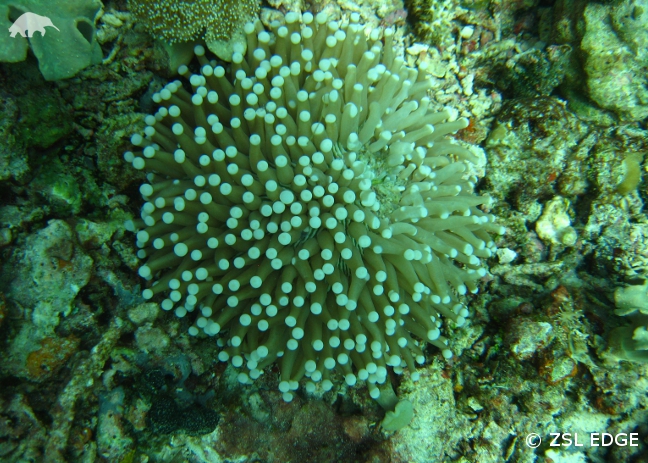
 My group choose “A study on abundance and the distribution pattern of mushroom coral (Heliofungia actiniformis) and its association to symbionts in different habitat conditions”, looking at sites in Sampela and Pak Kasim Hoga Island. It was a great opportunity to learn to survey coral reef ecosystems and reef fish, and learn the advantages and disadvantages of each survey method. Using the coral finder to identify species was very helpful. We also introduced a very interesting observation using a stereo video, this highly effective way to observe fish abundance including quickly measure the biomass.
EDGE Coral Reefs training activities greatly helped us to recognize and manage coral reef environments skills we can later apply to our work location. Through some good case studies in Indonesia, Malaysia and the Philippines, we can look at what needs to be studied and how to carry out this correctly.
What made it even better was Hoga island, since it is a great diving location with rich marine diversity, and large-sized reef fish can still be found in this region. In addition we were also invited to study the life of the Sampela Bajo tribe known as the tribe of sea; we had a chance to look at how they interact with the marine environment for resources etc.
I want say thanks to the ZSL and in particular Catherine Head for giving me a part in this training course, it was really useful and full of new ideas. My mind is now wide open to important knowledge about coral reef conservation activities. There are a number of damaged reefs in Indonesia, where I am from, because of our lack of understanding of the actual ocean conditions. I just finished masters in environmental science, and now I want to do research by applying knowledge from the training and focus on the distribution of EDGE Coral Reefs priority species.