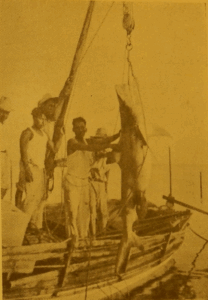
For thousands of years, shark fishing has been part of life along Mexico’s Yucatán Peninsula. What began as small-scale and traditional fisheries, grew into industrial operations over the last century and although these fisheries declined over time, the ocean bore the scars, some shark species slipping away, unnoticed, like shadows fading into the depths.
Take my favourite species, the Lemon Shark. Once a familiar presence in these coastal ecosystems, females would return every year to shallow nursery areas to give birth. Their predictable patterns, valuable meat, and even more prized fins made them an easy target and over time, their numbers dropped. But the decline was so gradual, so quiet, that hardly anyone noticed. Now, Lemon Sharks have become little more than a memory, spoken of by the oldest fishers and unknown to most young people growing up near the sea.

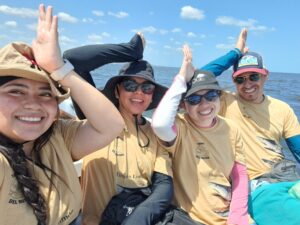
I’m Ilse Martínez Candelas, an EDGE Shark Fellow from Mexico, and I’ve made it my mission to find what remains of this species in the waters of Campeche and Yucatán. How do you search for a species that has almost disappeared from both the ocean and public consciousness? It starts where all good science does: with boots on the ground and then fins in the water.
Fieldwork is many things: thrilling, exhausting, unpredictable. But recently, I learned it can also be humbling in ways you don’t expect. For the past eight years, I’ve dedicated my life to studying shark and ray fisheries along the coast of Campeche, Mexico. I’ve travelled the coastline, sat with nearly a hundred fishers, listened to their stories, shared meals, made friends, and gathered knowledge that made me feel confident, maybe even a little too confident, about what I thought I knew.
So, when it came time to expand my research into neighbouring Yucatán, I thought, how different could it be? The ecosystems are similar. The history, intertwined. The cuisine? Practically the same. In Campeche, I had found over 60 fishers who could speak about the elusive Lemon Shark, surely I’d find the same in Yucatán. Right? Yeah… not quite.
From the moment I arrived, everything felt… different. Fishers weren’t just unfamiliar with the Lemon Shark, they didn’t even use the same common names for sharks I thought I knew. It was like stepping into an alternate universe. My confidence? Gone. Cue the existential crisis.
After a few awkward, failed interviews, I realized I needed to pause. Take a breath. Reassess. It took one minor panic attack, two incredibly patient (and slightly worried) field assistants, and a peaceful Yucatán sunset to remind me of something simple but powerful: this is what science is supposed to feel like. Uncertain. Messy. Full of surprises. Magic.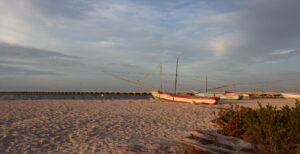
I’d gotten comfortable, maybe too comfortable. My work in Campeche had become a rhythm I knew by heart. But here? I had to start from scratch. Just like I did years ago, when I was a wide-eyed master’s student with no clue how fisheries worked, only a deep curiosity and the drive to figure it out. And maybe, that’s exactly where I needed to be.
Before you even set foot in the field, there are months of planning, budgeting, and researching. Funding is so hard to come by that you feel an intense pressure to make every cent count. So naturally, I wanted everything to go perfectly. But now, looking back on those early planning stages, I can see there were signs that this wasn’t going to be the smooth journey I had imagined.
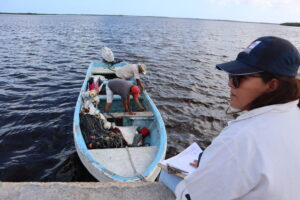
For one, there were almost no scientific papers about shark fisheries in Yucatán. That struck me as odd, but I brushed it off, assuming most shark researchers were simply focused on Campeche. Turns out, there was a reason for that silence: shark fisheries just aren’t a big deal in Yucatán. Great news for the sharks… not so great when you’re trying to track down seasoned shark fishers who might know about a disappearing species like the Lemon Shark.
Some people call me stubborn and maybe they’re right. But that stubbornness is what kept me going. I didn’t give up. And eventually, we did find the fishers who held the knowledge we were searching for all along.
That same stubborn streak, the one that kept me searching when things got tough, is also what pushed me to chase every opportunity to keep my shark research alive. It’s what led me to the EDGE Fellowship. I poured my heart into writing the project of my dreams: a mission to work side by side with local fishers to track down and protect the elusive Lemon Shark. And somehow… here I am.
In 2024, our search officially began across Yucatán and Campeche. Slowly but surely, with the support of fishers, researchers, and local institutions, these ghostly sharks started to reappear. First, fishers began reaching out to tell us they had caught Lemon Sharks. Thanks to Francisco and Luis Enrique, our collaborators in Campeche, we were able to measure them, log their locations, and piece together a clearer picture.
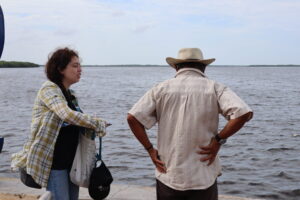
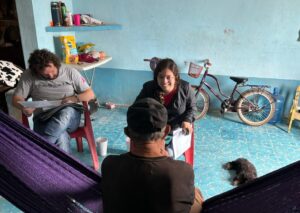
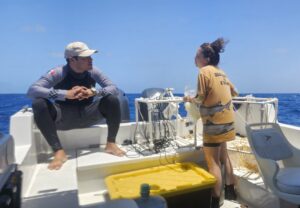
Then came a breakthrough I’ll never forget, with the help of Alejandra, Jalil, and Cristóbal, incredible local researchers who’ve stood by us from the start, we found live newborn Lemon Sharks in a remote coral reef! What once felt like a fading memory was suddenly, thrillingly, real right in front of my eyes.
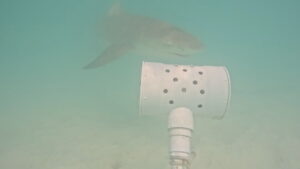


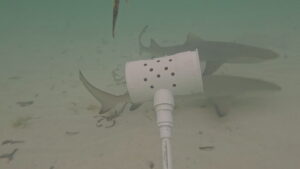
Even with years of research and solid science behind you, the ocean doesn’t always give up its secrets. You can search and search… and find nothing. But what made this journey different, what made it successful, was the people.
This wouldn’t have been possible without more than 110 fishers who generously shared their knowledge, the local researchers who believed in me enough to help lead this work, and the incredible EDGE team who supported me every step of the way. Together, we turned scattered memories into solid evidence. Finding Lemon Sharks has been one of the biggest milestones of my career, but this is just the beginning.
Now, we face even bigger questions that can only be answered through collaboration. Fishers, scientists, and institutions will need to work together to truly understand and protect this species. Sharks and fishing communities… it’s a complicated relationship, but after so many years working across the Yucatán Peninsula, I can honestly say: fishers have become some of my greatest allies, and, in many cases, my friends.
Without their stories, their fading memories of Lemon Sharks from long ago, we might have lost this species forever, without even realizing it. Sharks are part of this region’s past and present. And if we continue working together, they’ll be part of its future too, one where science, community, and conservation move forward hand in hand pushing for the well-being of local people and sharks alike.