.
.
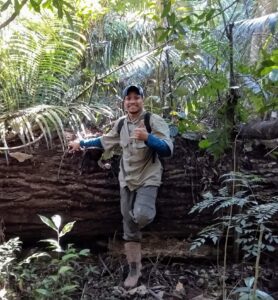
Hi, I’m Lucas Barreto, an EDGE Fellow, and I invite you to join me on a journey into one of the Atlantic Forest’s most fascinating and least-known conservation stories. This blog is not only about a species fighting for survival, but also about the people, partnerships, and opportunities that make this work possible.
.
A giant hidden beneath our feet
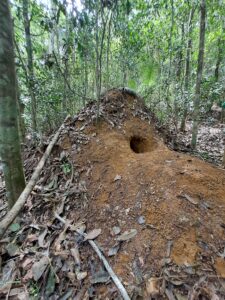
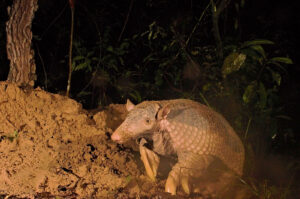
The Giant Armadillo (Priodontes maximus), the largest and rarest of all armadillos, is an animal capable of crossing entire landscapes without ever being seen. Living mostly underground and occurring at extremely low densities, it leaves behind only subtle clues: a massive claw mark, a fresh mound of earth, or the entrance to an impressive subterranean chamber.
Despite ranging across much of South America, the Giant Armadillo remains one of the continent’s least-studied mammals. In the Atlantic Forest, its situation is even more precarious. Here, the species is classified as Critically Endangered, a stark reflection of decades of habitat loss and fragmentation.
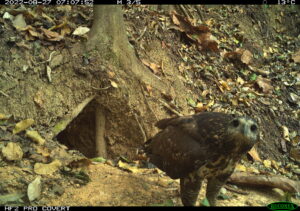
Yet this elusive giant is also a powerful ecosystem engineer. Each night, as it digs a new burrow, it reshapes the environment. These burrows become essential refuges for hundreds of species, mammals, birds, reptiles, amphibians, and countless invertebrates, forming an underground hotel that sustains life far beyond the armadillo itself.

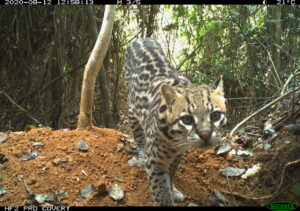


A sanctuary in the Atlantic Forest
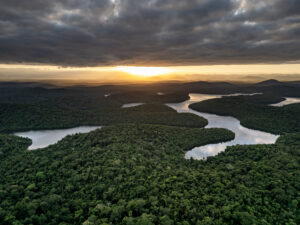
Since 2020, our team has worked intensively in the Rio Doce State Park, one of the last large and continuous forest remnants in Minas Gerais. Using a network of more than 54 camera traps across roughly 36,000 hectares – an area equivalent to 50,000 football pitches – we identified 40 individual Giant Armadillos and documented the highest density ever recorded for the species in the Atlantic Forest biome.
While these findings are encouraging, they also point to a sobering possibility: as the last large, continuous forest in the region, Rio Doce State Park may harbour the last viable population of Giant Armadillos in the Atlantic Forest. This realisation places an enormous responsibility on our work in the park.
Yet, protecting a species cannot stop at park boundaries. Over the past year, we expanded our monitoring to surrounding forest fragments, where we recorded four additional individuals. These discoveries highlight the urgent need to understand how Giant Armadillos move across the landscape and to strengthen habitat connectivity beyond protected areas.

Photos kindly provided by Fernando Faciole. Copyrights for this image are reserved to the author.
© Fernando Faciole


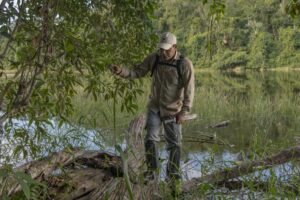
Why community matters
The challenges are many. Giant Armadillos reproduce slowly, producing a single pup every two to three years, all while their habitat continues to shrink. In this landscape, conservation cannot succeed without the people who live alongside the species.
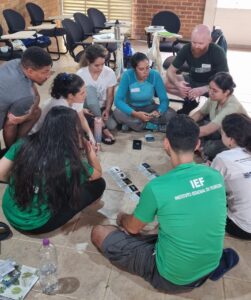
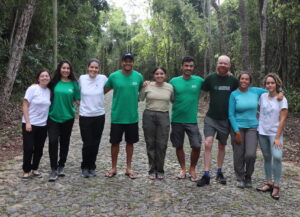
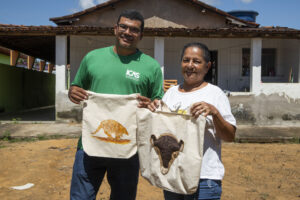
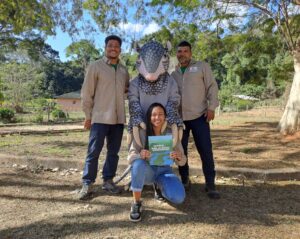
Through environmental education, collaboration with women artisans, and direct engagement with rural communities, we have built a network of local partners who recognise the Giant Armadillo as a symbol of pride and a reminder of the value of preserving this forest. Together, we work to reduce conflict, strengthen coexistence, and inspire the next generation of guardians of the Atlantic Forest.
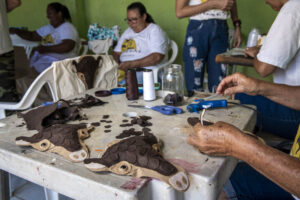
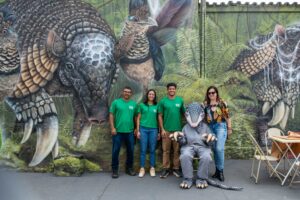


Photos kindly provided by Fernando Faciole. Copyrights for this image are reserved to the author.
© Fernando Faciole
.

How the EDGE Fellowship transformed this journey
Participating in the EDGE Fellowship with the Zoological Society of London has been a defining opportunity in my career. Being part of this global programme connected me with mentors and Fellows from across the world, each facing unique conservation challenges but united by a shared goal, protecting Evolutionarily Distinct and Globally Endangered species.
This international exchange has been deeply enriching in every sense, technically, professionally, and personally. The project supervision is dedicated and supportive, always ready to provide strategic guidance, while the communications team amplifies our work, ensuring that the story of the Giant Armadillo reaches beyond Brazil and resonates with audiences worldwide.
Living this experience has accelerated both my professional growth and the project’s development. It opened doors, strengthened my scientific foundation, and expanded the reach and impact of our fieldwork. Above all, the EDGE Fellowship builds lasting connections, creating a global community of conservationists who inspire, challenge, and support one another.

Looking ahead: A connected future
The future of the Giant Armadillo in the Atlantic Forest depends on robust science, meaningful local engagement, and a shared vision for conservation. Every new record, every forest fragment explored, and every conversation with local families brings us one step closer to securing the survival of this extraordinary species.
Our next major step is to strengthen landscape connectivity. For a species with large home ranges and naturally low densities, isolated patches limit movement and reduce genetic exchange. Creating and restoring habitat corridors will be essential, not only for Giant Armadillos but for the entire community of species that quietly depends on them.


Photos kindly provided by ICAS and Fernando Faciole. Copyrights for this image are reserved to the author.
© ICAS
© Fernando Faciole


Join us
The survival of the Giant Armadillo and the ecosystems it shapes depends on collective action. By supporting conservation projects, sharing knowledge, or engaging in local initiatives, everyone can help ensure their survival.
Together, we can ensure that this ancient, mysterious giant continues to roam the Atlantic Forest, shaping ecosystems, inspiring wonder, and reminding us why protecting the natural world matters.
Let’s turn awareness into action and safeguard the home of the Giant Armadillo, so that it can continue to weave life and wonder into this forest for generations to come.
2024 EDGE Fellow