TOP EDGE Corals
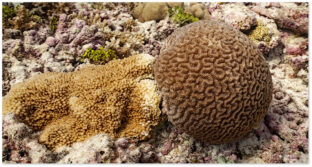
Mountainous Star Coral
Orbicella faveolata
Subject to a recent name change (previously known as Montastrea faveolata), Orbicella faveolata was distinguished from Orbicella annularis in 1994.
Conservation Attention
Low
Lithophyllon ranjithi
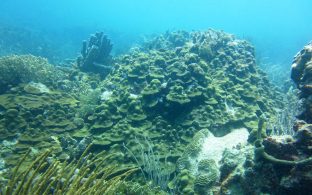
Lithophyllon ranjithi
This endangered coral species has a range which is restricted to one small area off the coast of north-eastern Borneo where it is easily misidentified as a closely related species, Lithophyllon undulatum.
Conservation Attention
Very Low
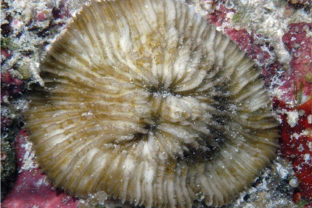
Pillar Coral
Dendrogyra cylindrus
Commonly known as Pillar Coral, colonies of this species are found in flat, sheltered locations ranging from the southern tip of Florida down to the coast of Venezuela.
Conservation Attention
Very Low
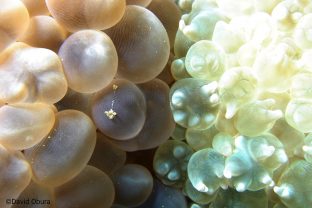
Pearl Bubble Coral
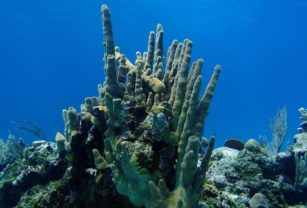
Physogyra lichtensteini
Commonly known as the Pearl Bubble Coral, Physogyra lichtensteini is distinct due to its fleshy vesicles which are on display throughout the day providing refuge for several marine invertebrates including shrimp.
Conservation Attention
Very Low
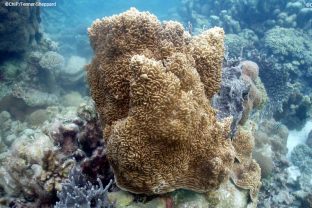
Elephant Skin Coral
Pachyseris rugosa
Commonly named as the Elephant Skin Coral due to its wrinkly appearance, Pachyseris rugosa is a fairly common species on tropical reef systems within its range.
Conservation Attention
Very Low
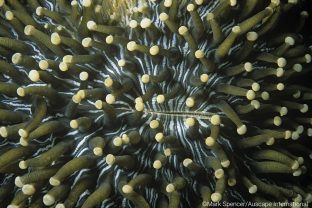
Heliofungia actiniformis
Heliofungia actiniformis
Unlike many Scleractinian corals, adult polyps of Heliofungia are solitary and free living.
Conservation Attention
Medium
Ctenella chagius
Ctenella chagius
Ctenella chagius (Chagos brain coral) may be the world’s most endangered coral lineage. A monotypic genus, it is a member of the Euphylliidae family and is found exclusively in the Chagos Archipelago Strict No-Take Marine Protected Area in the Central Indian Ocean. Its habitat has been historically protected from direct anthropogenic impacts such as overfishing and other destructive activities; however, reefs within the region have been subject to recent mass bleaching events with high subsequent mortality and loss of habitat. A relict population scattered widely throughout the Archipelago continues to survive.
Conservation Attention
Good