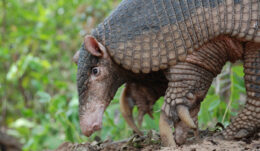
Four top priority EDGE species have been highlighted in a unique fashion collection, Simply Rare, which features the long-beaked echidna, slender loris, saiga antelope, and long-eared jerboa.

Student Rachel Browne designed the pieces as part of her final collection for her degree at the Arts University College Bournemouth.
Rachel wanted to highlight the plight of these animals through her work, saying “I didn’t realise just how many of these animals I had never seen before… hopefully through my chosen medium this will show how we are endangering these unique creatures lives, and in turn gain support.”

In Rachel’s words:
Simply Rare is a six outfit collection inspired by the vast number of unknown endangered species that span our natural world. The aim of this collection is to show the plight of four of these unique creatures before they disappear forever, silently and in the shadows. It is important to portray this issue to a wider audience so others become aware of the situation and see just how special these animals truly are. To produce this vision a variety of nine individual prints have been beautifully created with a mixture of hand crafted and digital processes to create a quirky, one of a kind collection.

Rachel has already achieved her aim of raising awareness - her saiga antelope terrence skirt was featured in the Sunday Express fashion supplement on May 30th and on the Express website.
We wish Rachel the best of luck for tomorrow when she will be showing the collection at Graduate Fashion Week.
To support EDGE conservation projects for forgotten species, please donate here.


During a follow up visit to the Foja Mountains of Papua, scientists from Conservation International and the Indonesian Institute of Sciences have recently announced the discovery of two new undocumented mammals.
The team set off the revisit the Foja Mountains, where in 2005 they discovered dozens of new species of plants and mammals, resulting in the region being described as a “Lost World”.
Papua still has large tracts of intact rain forest, and the Foja region which is part of the Mambero Basin is the least developed or “unroaded” tropical forest in the Asia Pacific.
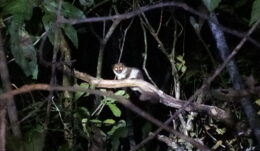
During an expedition in June last year, conservationists surveying the area came across two remarkable and unfamiliar mammal species. The discovery of a Cercartetus pygmy possum, one of the world’s smallest marsupials and a Mallomys giant rat are testimony to the unique, and possibly undiscovered biodiversity Papua still holds.
The giant rat is said to be about five times the size of a typical city rat and apparently exhibited no fear of humans, visiting the camp on numerous occasions.
Both mammals are currently being studied further to confirm their status as separate species.
In addition to the incredible mammal discoveries, during the survey, scientists also recorded mating displays and photographed many rare birds for the first time.
The team also found incredible plant species such as a “Giant White” Rhododendron, a species yet to be described and possibly the largest of any rhododendron species in the world.
To see more photographs and read more about this incredible expedition, please visit:
http://www.conservation.org/campaigns/Pages/foja.aspx#
The EDGE of Existence programme is very keen to send out a team to revisit Papua (Dr Jonathan Baillie returned from an expedition to the Cyclops Mountains in May 2007, see his exciting discoveries here) .
The ZSL EDGE Programme, together with partner organisations Conservation International and the Indonesian Institute of Science, plan to survey the Cyclops Mountains Nature Reserve for our Number 2 EDGE species, Attenborough’s long-beaked echidna (Zaglossus bruijni).
This species has not been seen since 1961 and there are no existing photographs or footage of this animal other than a photo of the type specimen. However during his recent exploration of the Cyclops Mountains, Jonathan Baillie discovered some compelling evidence that Attenborough’s long-beaked echidna still survives. A series of nose pokes were found and local community members gave accounts of seeing (and eating) this rare and cryptic animal.
EDGE are currently fund raising to get a team out to this remote location and to secure an EDGE Fellow to continue work in Papua.
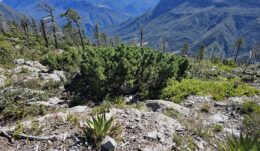
Papua still boasts over 40 million hectares of tropical forests and contains some of the richest biodiversity in the world; however it is not immune to the increasing threats from clearance for palm oil plantations and illegal logging. Expeditions like these highlight the need to protect such valuable ecosystems and ensure they remain untouched safe havens for countless unique species.
When I heard the birds of paradise calling I knew it was time to get up. As I stumbled out of my tent it was still dark in the forest, but I could see that Wandi was ready to start hiking. After ingesting a pack of noodles we started quickly making our way along the salt trail. Wandi was just as keen as I was to make it to the higher peaks of the Cyclops Mountains and our pace began to feel like a slow jog.

This time we discovered where we had lost the salt trail the day before and were able to continue walking along the ancient path. This made the walk a little easier as we were able to navigate the endless ridges. However, we were subjected to more swampy areas and had to wade through large pools of stagnant mud.

At this pace I was certain that we would be near the top well before noon. We knew there were no water sources in the higher peaks, so we made sure to fill all our water bottles before it was too late.

By 8:30 we were already at the ridge of the mountain overlooking Ormu. Here we found more signs of where an echidna had been foraging (1,250 m). We followed the ridge toward the peak, just as Van Royan, the Dutch Botanist who discovered Attenborough’s echidna, must have done 46 years ago. Along this ridge at about 1,300 m was the last sighting of any human disturbance. All the smaller trees had been chopped down and it looked as though the area had been cleared for a small hunting camp.

The ridge then became very narrow and steep and the trees were mostly covered in a light layer of moss. We now had to cut our way through the foliage with a machete and often had to pull ourselves up vertical inclines by grabbing onto the base of small tress, often covered in small spines. We were moving quickly and I could feel my adrenalin rushing as I knew we were within an hour of being at the site I had read about so long ago and had been desperately trying to reach for the past month.

When we finally reached 1,600 m we stopped to eat some food and searched the area for any signs of echidnas. We were drenched in sweat as we had been hiking in the hot tropical forest since 5:30 in the morning, but now with the cool breeze moving through the cloud forest I began to feel very cold and realized that a night in the clouds would be less than comfortable. The trees were now covered in thick moss and everything was cold and dripping wet.

As I searched the forest floor for signs of echidnas I was surprised to find that caterpillars and moths were happily surviving in this damp environment.

I pulled up a matt of moss and was able to find a number of earthworms that would be an excellent food source for Attenborough’s echidna. Their long beaks and jagged tongues likely make them expert worm hunters. I realised that finding nose pokes in this environment would be extremely difficult as the ground was either covered in dense moss or deep layers of leaf litter. I found many crevasses, hollow logs and small borrows that would provide echidnas with perfect hiding spots to wait out the day. One group of species that were noticeably absent were leeches. I found this entertaining as the villagers had told me to expect three species of terrible leech.

We then continued up the narrow ridge manoeuvring between damp trees and hopping across large slippery moss covered bolder with hundreds of meters free fall on either side. The orchids were numerous and beautiful and unlike any I had seen before. It now made perfect sense that Van Royan had ventured to this remote ecological island.

I found it interesting that Wandi knew that the plant shown below, which has a symbiotic relationship with ants, was being used in cancer research. I only wish people in the western world had the same understanding of the importance of genetic resources in the rainforest.
Every time we thought we had reached the summit the clouds would thin and we would see that we had to keep going. At one point we stopped and climbed out to a rocky outcrop to see if we could identify Santani. It was only for a second, but my stomach sank as the white cloudy abyss suddenly morphed into a deep green vertical drop. We sat silently for a while and listened and other then the odd bird chirp it was deathly quite. The moss appears to absorb the sound much as the snow does in winter. The birds were extremely tame, almost curious and came within meters of us to get a very good look at the strange looking primates. Even cassowary droppings could be found in this unlikely location. Half an hour later we were at the top of this part of the Cyclops mountain range which was about 1,700 m. Wandi was more than pleased with himself for having successfully guided us here.

He insisted on taking a picture of me on the summit so I handed him my camera, but forgot to explain the focus bit.

After about an hour at the top searching for signs of echidnas we began to get cold and knew we had to head back if there was any chance of us returning before dark. No nose pokes were found at the summit, but it would have been pretty hard to identify them given the ground cover. After circling the summit a number of times we quickly descended. I was in another world, thinking about how to best conserve Attenborough’s echidna when suddenly I clued in to the fact that Wandi was not following the cutting marks we had made on the way up. He indicated that he did not need to because it was impossible to get lost on such a small ridge. Something felt strange and I pulled out my compass only to find that Santani was on the opposite side of where it should be if we were heading back the way we came. Wandi put his palm on his forehead and shook his head. The mystical cloudy mountains had deceived him and we had descended about 250 m on the wrong side of the mountain.
Feeling rather far from camp we retraced our steps to the top and after a few circles and a bit of confusion (Wandi tried to take us down the wrong side again) we headed back in the direction from which we had come. With the thick clouds and multiple ridges it was really disorienting and even I began to wonder about the deceptive mystical nature of the mountain. I insisted that we follow the trail that we had cut on the way up the mountain, but after descending into endless valleys crossing countless rivers and climbing up ever steeper ridges it became clear that following a cut trail was not Wandi’s greatest forte. With the GPS we were able to get periodic readings which guided us in the general direction of camp. After 18 hours of challenging hiking, many of which were spent stumbling in the dark, we knew we were close to our camp when we smelt smoke in the warm night air. We called into the forest and were ecstatic to hear the welcoming hollers of the Forestry guys. Once I could see the comforting lantern in the distance my body began to feel tired.

When we came out of the mountains I met with the EDGE fellow that will be developing a monitoring and education programme with the different tribes at the base of the Cyclops Mountains. She will also be responsible for developing a basic management plan for Attenborough’s echidna in the Cyclops Mountains. This work is being carried out with the assistance of our local partner, Conservation International.
When I got on the plane to fly home I look at my seat and it said smile ‘n care.

I had a hard time mustering up a smile as every muscle in my body hurt, but I could not have been happier with the knowledge that Attenborough’s echidna was still inhabiting the Cyclops Mountains, that its distribution is probably larger then we previously thought, that all the descriptions were consistent with it being a distinct species, an EDGE fellow was now in place and that the local tribes were keen to conserve the culturally important species that they fondly know as the Payangko.

We offered Wandi a place in the tent, but he preferred to sleep by the camp fire.

I don’t think he slept much as the camp had been completely transformed by morning. It looked like something out of Gilligan’s Island.

When I asked him how he slept he said it was great except for the snake that joined him on his wooden bed.

After a large Papuan style breakfast of rice and spam we began our search for the salt route which we hoped would take us to the mountain ridge overlooking Ormu. The forestry guys were in good spirits, keen to find more signs of Attenborough’s long-beaked echidna and to be the first from their department to climb the Cyclops.

Within half an hour we found the salt route and were able to follow it by identifying old branches that had been cut. I stopped to remove some leeches that were burrowing in my socks and crawling up my leg. The forestry guys quickly pulled out a small bottle and eagerly plucked them off me and added them to the collection. In sign language they made it clear that these leeches were somehow used as a local Viagra. I still wonder exactly what they do with them.

The forest looked extremely wild and untouched, but every so often we would come across branches that had recently been cut.

We also found old hunting camps and wooden snares. One camp at 800 m had about 40 unused sapling snares lying against a tree. The Cyclops Mountains are surrounded by a number of different tribes, most of whom do not spend time in the higher peaks. However, migrants from the highlands have begun to settle the base of the southern side of the Cyclops and these tribes, such as the Lani or Dani, are excellent hunters and think little of climbing what to them is a small mountain. As we hiked further up, the forest began to look very prehistoric with a variety of ferns and moss dominating the landscape.

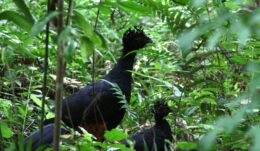
The prominent dinosaur-like tracks of cassowaries (a large flightless bird) reinforced the feeling that we were entering a Jurassic forest.

After some time, Wandi lost the salt trail and it was clear we were no longer heading for the ridge. Instead, we had veered slightly west and were moving towards one of the peaks. This was fine, but we had to slowly cut our way through the forest as the mountain continued to get ever steeper. The team seemed tired and I began to come to terms with the fact that we were not going to reach the summit. It was 2pm and we were at about 1,500 m. If we kept going for much longer there was no way we would make it back before dark. When we hit a cliff face and a large steep rock slide I decided it was time to start heading back. This was very upsetting as I had been trying for weeks to get to the elevation of 1,600 m where Van Royen found the only known Attenborough’s echidna specimen. Before turning back I scoured the forest floor for any signs of echidna’s and while the area looked like perfect echidna habitat and there were many potential borrows or hiding spots, I found no signs that I could confidently say were those of the echidnas.

Wandi decided to try and take a shortcut back, but after encountering endless valleys, rivers and cliff faces it became clear we were completely lost.

When the sun set everyone looked a little nervous but the evening calls of the frogs and scratching noises of the insects were comforting. We all knew that if worse came to worse, we would be safe sleeping on the forest floor.

On the positive side, I knew that hiking at night would greatly increase our chances of seeing the nocturnal echidna. In the dark we came across interesting bite marks in a tree which I think were caused by tree kangaroos.

The tree kangaroo species, known to live in the Cyclops, is the grizzled tree kangaroo which is grey in colour.
It was difficult to use my GPS as there was thick cloud cover and the forest canopy was very dense. However, by patiently waiting in the middle of an open stream, I could sometimes get a waypoint and it was possible to identify the general direction to the camp.
In the dark we waded through large patches of plants that were very similar to nettles, but with a more painful and long lasting sting. An entomologist working in the region in the 20s wrote that this plant would bring tears to the toughest of men.

I forgot all about the nettle-like plant when a swarm of black bees attacked me as I tried to cross a river. I was a bit worried about the number of times I had been stung on my face, neck and hands, as I thought I might not be able to walk, but when the last bee had left or had been killed, I realized the stinging sensation was not that bad and it only stayed with me for a few minutes.
I was able to then take a waypoint in the river and was relieved to discover that after 14 hours of hiking we were less than 0.25 km from the camp. We climbed out of a steep, rocky valley onto a ridge where we found what seemed to be a path. Wandi was overjoyed to be back on track and was impressed by the power of the GPS, which he called “machine”. He was confidently walking along the path when suddenly he stopped and nervously smiled and said it was time for him to go home to his wooden house at the base of the mountain. I could not understand as we were only minutes from the camp and it would have taken him another 6 hr to reach home. He then pointed to a branch, hanging 8 feet off the ground, that had been cut by a machete. He explained that it could have only been done by a forest giant. He was getting ready to run for it, but waited to entertain our plausible explanation that it was indeed us that had cut the branch earlier that day. Without the weight of the end of the branch it has risen. Not entirely convinced, he agreed to continue with us in the direction of the camp. After 14 and half hours of hiking we finally arrived at the camp.

I was less than unpopular when I suggested that the next day only Wandi and I would wake up at 5:30 and try and climb to the top of the Cyclops.
To be continued…
We quickly moved over to inspect what the hunter described as a “Payangko feeding hole”. Immediately the hunters agreed that this is where an Attenborough’s echidna had recently been feeding. I was skeptical at first, but upon inspection the feeding marks looked like classic echidna nose pokes. When echidnas feed they probe their long beak into the ground, leaving a deep conical imprint in soft soil or leaf litter. Sometimes this print even provides an outline of the top the echidnas head. The drawings below demonstrate the various imprints typically left by long beaked echidnas.

There were three good examples of these ‘nose pokes’ in the soil in relatively close proximity, and a fourth nearby in a large termite mound. The location of the fourth nose poke was quite interesting because while the short beak echidna commonly feeds on termites, this has not been documented in long beaked echidnas. However, the termite mound looked a little old - so it is possible that it was feeding on invertebrates other then termites. Echidnas commonly spend their days in a burrow or under a log and feed in the evenings, so we decided to come back to this location the following night to see if we could find the animal while it was active.

Leaving the nose pokes, we then followed a mountain ridge south until we reached the site where the last documented Attenborough’s echidna had been killed and eaten. Ben showed us where the strange animal was snared and the coals from the fire where it was eaten. He described taste and the anatomy in detail, leaving me with little doubt that he had consumed the creature.
I was amazed that the site was only 166 m above sea level because Attenborough’s echidna was thought to only exist in the highest peaks of the Cyclops Mountains. This finding is very encouraging as it slightly extends the known distribution of the species.
When we arrived back to our base we received news that the Ormu tribe was willing to let us visit, but that we would have to make a donation to the church of about $300. I very much wanted to go to Ormu as it appeared to be the easiest place from which to climb to the top of the Cyclops Mountains, but I did not think a rather large forced donation to the church was the best way to start a conservation partnership. I asked Yahoda’s brother to return to Ormu to explain that we were doing and re-negotiate.

In the meantime we gathered all the camping equipment and made our way back to the site where we has seen the echidna tracks. That night we sat silently in the darkness waiting and listing for a small spiny mammal foraging in the earth. We did the same the following night at the site where the echidna had been eaten. Twice I heard an animal moving in the dark and quickly aimed my light in the direction of the moving vegetation. The first creature was a small terrified bandicoot, and the second, an irritable fruit bat. I also came across many strange invertebrates that I had never seen before such as this enormous spider (I would be grateful if someone could identify it for me) but alas, no echidnas.
When we returned to our base Yahoda’s brother told me that the Ormu tribe had now decided to let us visit, but that we would have to pay $600 instead of $300! I laughed, and started packing for Dormena. From Dormena it would be a long hike from the central mountains to the higher peaks, but I thought it would still be possible. I also wanted to go there to see if we could track down the old man who had a story to tell about the echidna.
When I got to Dormena I asked for the old man, who was named David Abusay. The villagers told me that he was not around. When I asked when he would be back they said he was dead. They then brought his younger brother to tell me the story of the echidna. He told me that in 1920 his brother had caught an echidna, and that this was the last time that one had been used for their traditional peace ceremony. He explained that if there is conflict between two people or two families, eating an Attenborough’s echidna together would bring peace. I also heard a slightly different story from another old person who said if someone had done something wrong in the village they would have to either pay a fine or find an echidna – and most people ended up paying the fine. The second story indicates that they have been rare for some time. It was wonderful to hear that the species was culturally significant, but unfortunate that the echidna had to be consumed during the peace process.
When I enquired about climbing to the higher peaks it sparked a major discussion leading to a village meeting that continued late into the evening. At 11pm the village chief finally came to the house where I was waiting. Nothing was said for the longest time, but the outcome was clear. He finally told me that we could not go into the hills above their village because foreigners never go there and they were also worried about the safety of our guide Yahoda, as the mountains were a very wet confusing and dangerous place. There was also a concern that we might anger the mountain and cause a landslide. They told me this happened many years ago when some people ventured into the hills behind the next village.

I was very disappointed as I was determine to get to the site where Pieter van Royen found the type specimen, but at the same time I was happy that these local customs were reducing pressure on what is likely to be the echidna’s key habitat. I knew at this point that I was not going to be able to climb the mountains from the North side and would have to go back to Jayapura and go through the long permission process again to climb the southeast part of the mountain range that was owned by a very different tribe with a different language and traditions.
On our way back to Jayapura I studied the southern slops of the Cyclops Mountains. I also re-read all of Van Royan’s field notes and was able to identify the exact place his journey had begun some 46 years earlier. I then got permission for the Forestry Department, police, military, and the head of the Santani tribe to climb the south-east slope to the peak called Rafini. This time the Forestry Department decided to send two rangers with us as no one from the department had ever been to the top of Rafini.

We cut through thick vegetation following what used to be a major path called the Salt Route. In the days before motorboats people used to commonly follow this path from Santani to Ormu to trade for the much needed salt. A few hours into our hike I noticed some rustling in the tress and waited patiently hoping for a sighting of a cassowary or a tree kangaroo, but out came Wandi – the man that would ultimately guide us to the mysterious peaks. On the second day at 769 m above sea level we came across perfect echidna nose pokes. This time the imprints were very fresh. We decided it was a good place to camp because there was the possibility of seeing the echidna – It was also getting dark, we had completely lost the salt route, and there appeared to be cliffs in every direction. We decided the following morning we would attempt to find the Salt Route again, follow it to the mountain ridge and then head straight for the top of Rafini. I slept soundly that night with no idea of what difficulties lay ahead…
To be continued…