It has been over a month since my last update so I thought it was time to bring you up to date with everything that has been happening.
The last few weeks have been very busy and productive ones. The most exciting news I have to share with you is that with the help of our two intrepid research assistants (Nicolas Corona and Dionis “Lleyo” Corona) we have managed to catch both of our species (solenodon and hutia) in the wild. I cannot fully describe the excitement and huge privileged I felt to be able to hold and observe these unique animals. They truly are amazing and, I hesitate to say it, incredibly cute.

Trapping with standard baited cage traps had proved relatively inefficient and ineffective in the past for both species. Our new approach relies on the skills that our research assistant team possess and consists of a two step process. First, we searched areas during the day to look for the signs of both species; these include “nose pokes” for solenodon and signs of feeding for hutia (nibbled leaves and gnawed bark) along with the distinctive dung of both species. Secondly, after nightfall, we returned to the areas with the freshest signs to catch the animals by hand. Watching Nicolas and Lleyo at work I realised that it may take me a while to gain the skills that they have but that learning process has now begun.

Having caught the species we took the opportunity to do some basic recordings of the sounds that they make. The solenodon recordings consists of a series of clicks and high pitched calls that sound a bit like dolphin sounds to my untrained ears. The recordings for both species have raised a lot of interest with scientists who work with acoustics. We used the recordings to begin to trial playback experiments, particularly for the arboreal hutia, to see if they respond to the sounds but this has had limited success so far but we have not given up on this option by any means.
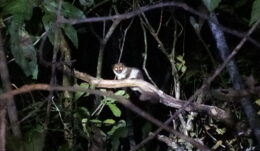
We have also done camera trapping with a great deal of success. We have been placing camera traps at the entrance to burrows of hutia, which are relatively easy to identify, as well as along paths left by both species. Our efforts have given us good results with some great footage of the comings and goings of a hutia family in addition to this we have the first film footage, as far as I know, of a solenodon in the wild.
Get the Flash Player to see this player.
Most of the work we have done so far has been done in a small number of forest patches running along steep valleys and gorges set in the middle of agricultural landscapes. First indications suggest that the hutia and solenodon appear to be holding on here but obviously we still need to assess how well they are doing and identify the particular threats they are facing in these areas.

Other project news includes the fact that the project now has its own truck to get us into all our sites including some of the most challenging ones. We have also entered the final phase of selecting a local counterpart project manager and will be conducting interviews over the next couple of weeks in order to select the best candidate. I look forward to introducing you to the successful candidate by the time the next update comes round.
In terms of raising awareness of the two species, we have been making progress at both the national and international level. We had a journalist from Der Spiegel (a very popular German news magazine) join us for a few days to report on the start of the project – you can see a video linked to the article at the Der Spiegel website. We have also launched two facebook groups called “The last survivors - Hispaniolan Land Mammal Project” and its Spanish language equivalent “Los últimos sobrevivientes – Salvando el solenodonte y la hutia”. If you join either of these groups you can look at a range of photos, listen to the sounds that both species make and see videos as well as getting more regular updates as to what is going on.

This month will see the launch of a competition in the Dominican Republic to design the logo that will be used to identify the project - we are hoping that as many people as possible from different age groups and backgrounds will participate and in doing so raise the profile of the project at the national scale.
The initial planning and preparatory phase of the project is gradually coming to an end, it has definitely been an eventful time so far but the next phase promises to be even more exciting. The amount of field work carried out will be increased in terms of both the amount of time spent in the forest and the extent of the work as we explore across a much wider area including three national parks and beyond. Something for all of us to look forward to in the new year.
If you would like to support the conservation of the Hispaniolan solenodon and hutia and the conservation of other unique species on the verge of extinction, please become an EDGE Champion, or donate here.
I, James Mwang’ombe, am Dorine’s local supervisor and the Head of the Taita Taveta Wildlife Forum.

The Sagalla Caecilian conservation project is one of the very important projects to TTWF as it targets to conserve a critically endangered organism while at the same time enhancing livelihood generation and survival for the local community through integrated resource management. Towards this end, several approaches are being employed through the application of various legal instruments that the Kenya Government has put in place.

Chief among these is the Forest Act 2005 that provides for community participation in forest management through a Community Forest Association (CFA) and a Participatory Forest Management Plan (PFMP). The formation of the CFA is well underway with a preparatory meeting having been held with village representative. This will be followed by a capacity building workshop where the elected representatives will elect interim officials and the preparation of Articles of Association will be undertaken. This will be followed by an application for registration at the Attorney General Chambers or Registrar of societies.
Following closely are the steps for PFMP preparation where data collection is on-going. This week, Dorine assisted by other staff of TTWF will be carrying GPS mapping of the forest boundary which will then be followed by a plant inventory which among other things will provide a checklist of the species list and forest data/measurements.

The other legal instrument we are applying is the Water Act 2002 that also provides for the participation of the local community in water resource management. We have initiated or supported the formation of Lower Voi river/Sagalla Water Resource Users Association (WRUA) that has applied for registration at the Registrar of Societies and also a Sub-Catchment Management Plan is in place. TTWF is in the process of assisting the newly formed WRUA to prepare a proposal soliciting for funds to build its capacity from the Water Services Trust fund.
On alternative livelihood generation, TTWF has introduced fishfarming as a way of sustainable utilization of the wet areas. By constructing fishponds, the farmers are able to generate livelihood without having to drain the water thus contributing towards creating a niche for the caecilian.
This is supported by directing rehabilitating the habitat through re-planting of indigenous trees. Currently, TTWF is promoting planting of two indigenous tree species (one being endemic) re-introducing them to the area, among others. These are Milletia oblata (endemic to Taita) and Prunus africana (a tree with a huge commercial potential through sale of its bark used for manufacture of prostate-cancer management drugs).


We believe this multi-pronged approach targeting various facets of conservation is the best way to achieve the overall conservation of the critically endangered Sagalla Caecilian i.e. policy and legislation to institute proper environmental management, reducing pressure on the natural resource by introducing alternative livelihood options and by involving the local people to manage their own resources.
There is a lot of work to be done and we are ambitious, however, we have challenges. These include inadequate finances and lack of equipment especially motorvehicle among others. We are extremely grateful to the Zoological Society of London for coming to our aid, and we appeal for others to also do so.
From the 18th to the 30th of November 2009, Adiya (Bactrian Camel EDGE Fellow) and Henry (Steppe Forward Programme Co-ordinator) participated in the Mongolian ungulate survey organised by the Mongolian Academy of Science’s Institute of Biology, funded by the World Bank. The survey’s aim is to establish an estimate of ungulate numbers across the eastern and southern regions of Mongolia and especially of Mongolian gazelle (Procapra gutturosa), goitered gazelle (Gazella subgutturosa) and khulan (Equus hemionus).

We were assigned the Gobi-Altai province in the southwest of Mongolia, home to most of the Great Gobi A Strictly Protected Area. Strictly Protected Areas are designated by the Mongolian government as regions for the preservation of wildlife. Herding and tourism are tightly controlled, and hunting and mining are prohibited. Although there are no Mongolian gazelle to be found here, there are plenty of goitered gazelle and khulan and is also the habitat of the wild Bactrian camel (Camelus bactrianus).

For most survey teams, the survey would be in the form of northerly transect lines, 30km apart. However, for our designated area the terrain is so rugged – vast uneven steppe with steep rocky outcrops hundreds of meters in elevation scattered across the landscape – that it would be impossible to conduct such a survey. We therefore used a combination of point count surveys on peaks for a good overview of the steppe habitat below where ungulates feed and also transect lines wherever possible. This revealed sparse but regular amounts of ungulates; mostly wild camels – sometimes in groups of more than ten – along with khulan, goitered gazelles and also Siberian ibex.

This distribution can be explained by the arrival of the winter season. Now that most of the Gobi is cold enough, the little moisture that falls as snow is immediately trapped on contact with the ground and blankets the landscape. This changes the location of wildlife dramatically as water is now available almost everywhere, although in solid state, and so ungulates do not need to rely on water points that are so vital to their survival in the summer months. As the saxaul plant (Haloxylon ammodendron) is also sparsely but widely distributed on the steppe habitat, ungulates can find food and water in all corners of the park. Saxaul conservation – which is used by herders and local people for firewood – is vital to the ungulates survival as it is their main food source.

Also November is the start of the breeding season for the wild Bactrian camel. Males are competing for females and starting to form herds, with the male generally at the back of the group to monitor the location of its members and guard from opportunistic young or feeble males who have not yet been able to form their own herd, if ever. We were lucky to find a number of these herds although they have not yet reached the size that they can extend to further into the winter season, some herds can rise to over a hundred individuals.
We hope that the results of all the survey teams will be analysed shortly so that we can all appreciate the best estimate so far of numbers of Mongolian gazelle, goitered gazelle and khulan in Mongolia. Hopefully more surveys like these will be made in the future to see how well ungulate populations are resisting to increasing threats such as climate change, overgrazing, poaching, illegal mining, the list can go on and on…

Finally, we would like to thank the Great Gobi Park Administration and their families for their kind collaboration, help, hospitality and kindness without which our part of the survey would not have been possible.
Hello. Dear Blog readers.
This time I am going to introduce our research about long eared jerboa distribution in Great Gobi Protected area.

Our research started 12th July - after Mongolian national celebration, called Naadam - and finished 25th August. We went total up to 5000 km roads. Sometimes we went without road. This is most wide area, which don’t live any people, except only rangers, border soldier. So going without some rangers and person who know roads and water resources is very dangerous.
Because we went to Great Gobi with senior expert of Great Gobi Protected area administration, we hadn’t any losting problems. Because of little car breaking, sometimes we used to go back soum center to replace broken part and petrol. In this area border soldiers used to help us very well.

We checked six site from 14 site of old Russian research (red numbered sites on map). So we found some long eared jerboa from 4 sites - sites 12, 4, 6, 3. In other words, in our research, long eared jerboa’s distribution was decreased by 34 percent of sites since 1974.
If this process continue without any conservation similarly, in 2050 long eared jerboa’s distribution will be decreased 42 percentages from current distribution. It is only elementary conclusion. When we look at this elementary conclusion, it seemed tragic. So I expected not only long eared jerboa’s distribution is decreasing, but also other desert rodents’ distribution is decreasing.

Our first site was front of Aj Bogd mountain. This site was west point of Old Russian research distribution. At that moment I thought whether there was long eared jerboa in this old site before set equipments on the ground. . .

…So tomorrow morning when we check all traps, we’re glad to see long eared jerboa. We found 2 jerboa in first day. Those were little beautiful Gobi micky mouses. I’ve written about long eared jerboa previous blogs. If you interest it, see EDGE blog.

Also we studied long eared jerboa behavior by using radio telemetry equipments. Research has looked at long eared jerboa behavior with overlap home range and illustrated that this species don’t like social communication. Long eared jerboa had specific behaviour jumping and kick by front leg each other during this meeting. After couple close each other, they ran actively.

In the end, I would like to represent my acknowledgements. When we go to Great Gobi desert studying long eared jerboa current distribution, PTES and ZSL-EDGE helped us very well. Also I thank National University of Mongolia teacher, local people, rangers, border soldiers, my assistant students and good driver very much.
If you would like to support projects conserving EDGE species - one of a kind species on the verge of extinction - please become an EDGE Champion or donate here.

Although the origin of the name “Ghost Frog” is unknown, it is believed that it originated because some frogs are found in Skeleton Gorge on Table Mountain. This makes a nice and attractive story, but the origin is uncertain. What I can tell you is that this one difficult frog to find!

There body is flattened and can hide in the smallest cracks and under rocks. Sometimes you hear them calling and you can even pin point under which rock or which crack, but finding them is another story. They are like ghosts disappearing into thin air or should I say cracks – my definition of why they are Ghost Frogs.

I was fortunate to be able to collect a sub adult male while searching for tadpoles early November this year. What a bonus seeing a frog in my net instead of tadpoles. In the last 12 months working on ghost frogs, this was only the third one I’ve seen. I only know of one other record reported by a local nature conservator working for MTO. This makes four records over the last 12 months. Before this the last reported sighting was before 2000.

To understand this secretive and rare species we need to do more research. I’m hoping to answer some of these questions in my quest of finding the GHOST of all the FROGS.
Read all of Werner’s blogs here.
To support projects conserving unique and threatened EDGE species please become an EDGE Champion or donate here.