Meet Fang Yan and Lv Jingcai, two EDGE Fellows who will be researching the Chinese giant salamander (CGS) in their home country of China. Found in much of central, south-western and southern China, the CGS lives in habitats of fast flowing streams and mountain lakes at altitudes of up to 1500m. It is the world’s largest amphibian and is known to feed on fish, snakes, crustaceans and frogs. Unfortunately, habitat destruction and exploitation for the food trade have caused population numbers to collapse and today the species is considered Critically Endangered and a top priority for the EDGE programme. Working as part of a conservation project funded by Darwin Initiative, Ocean Park Conservation Foundation, Hong Kong and US Fish and Wildlife Service Amphibians in Decline, both of our Fellows will be taking their own approach to aid in the conservation of this incredible species.
Fang Yan
I am Fang Yan, a Chinese girl from Lanzhou in northwestern China, and I am a doctoral candidate at the Kunming Institute of Zoology, Chinese Academy of Science.
 My research interest is the phylogeography and conservation of amphibians. Amphibians are important environmental indicators and ideal model species for discerning evolutionary processes. Unfortunately, amphibians are the most threatened animal group and seriously impacted by human activities. Many people think they are ugly and dirty; I still remember being scared to touch a frog in my biology class at college. But now I am so excited to go to the field to search for them. There are so many beautiful and interesting amphibians, many of which are new to science and drastically in need human protection. For example, the Liaoning clawed salamander (Onychodactylus zhaoermii) has just recently been identified. This species is a beautiful colour, with a slender body, and has black claw-like horny structures similar to a human’s fingernail. Amazingly, this species is believed to persist in just one small locality in Liaoning and, understandably, it is in urgent need of conservation attention.
Now that I am an EDGE Fellow, I will be focusing on the CGS, a species highly threatened by human activity. The aim of my EDGE Fellowship project is to study the population genetics of wild CGS populations and use this data to inform a conservation strategy for the species. This work forms part of a project aiming to ensure the long-term survival of CGS in their wild habitat.
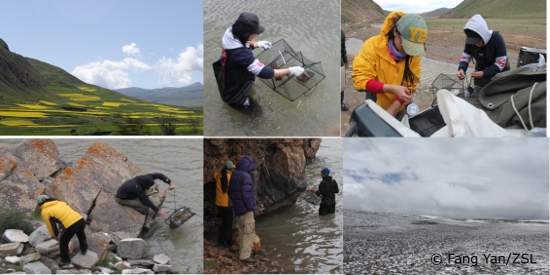
 So far, I have collected some wild genetic samples of CGS but important localities still need to be investigated. Qinghai is the most important distribution region for the species. Last year, we went to Qinghai to search for CGS but the variable weather was a great trial to us. It is amazing that CGS could live there for millions of years. We used traps and bait to lure the salamanders but unfortunately, none were detected.
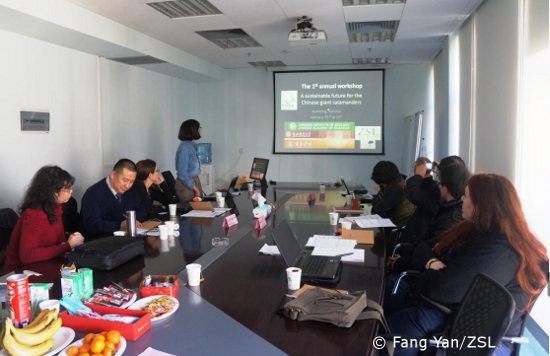
In January 2013, we held a wonderful workshop in Kunming. I was so happy to meet everybody involved with the project. Each project partner introduced their current research status and work plan and all of the EDGE Fellows took part in CEPA (Communication, Education and Public Awareness) training.
Lv Jingcai
 My name is Lv Jingcai, I come from Guizhou province, China. I am an MSc student studying at Zunyi medical college and my primary interest is the research of amphibians and reptiles. I have just started as an EDGE Fellow working on wild Chinese giant salamander (CGS) conservation in the Key Laboratory of Biodiversity and Environment Conservation in Guiyang University, China.
My EDGE Fellowship project will focus on the surveying, monitoring and management of CGS in Guizhou province, a biologically diverse and resource rich region of China. Alongside my surveying, I will also focus on Communication, Education and Public Awareness (CEPA) to ensure the goal of long-term conservation of this endangered species and its freshwater ecosystem.
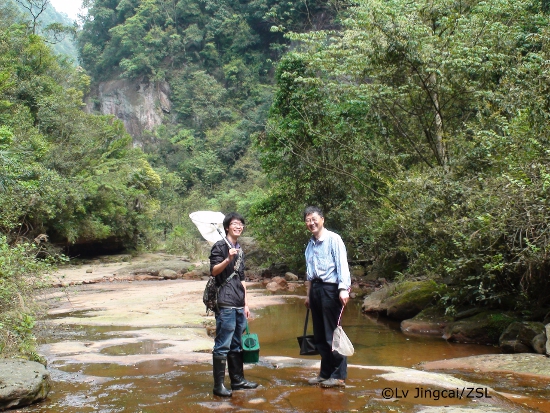 In 2011-2012 I participated in wetland research on the diversity of amphibians and reptiles in the protected areas of Guizhou province with my supervisor, Professor Wei Gang. Here I learned field survey skills applicable for collecting data on CGS distribution. All this knowledge is very important for my future work. I look forward to updating you as the project progresses.
To learn more about the project that Fang Yan and Lv Jingcai are working on, please visit the project page: “A sustainable future for Chinese giant salamanders”.