Evolutionary Distinctiveness
Order: Insectivora
Family: Erinaceidae
The family Erinaceidae consists of hedgehogs (subfamily Erinaceinae), and moonrats or gymnures (subfamily Hylomyinae). Hedgehogs can be easily distinguished from moonrats and gymnures by their barbless spines which cover their backs and sides. The Hylomyinae resemble primitive rodents with long muzzles. All members of this subfamily lack spines.
Fossil erinaceids are known from the middle Paleocene to the early Pliocene in North America (60-7 million years ago). The family also dates back to the early Miocene (25 million years ago) in Africa, the late Paleocene (55 million years ago) in Europe, and the Eocene (45 million years ago) in Asia.
The Hylomyinae comprises eight species in three genera (Echinosorex, Podogymnura and Hylomys). There are three species in the genus Hylomys: H. hainanensis, H. sinensis and H. suillus. H. hainanensis was formerly called Neohylomys hainanensis.
Size: Head and body length: 120-147 mm
Tail length: 36-44 mm
Weight: 50-70 g
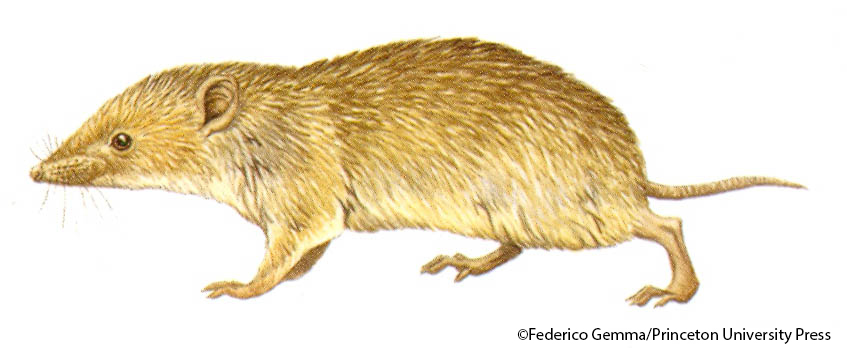
This insectivore has a long, blunt snout and well developed eyes and ears. The coat is a rusty brown or grey colour, with a long, black stripe running along the centre of the back. The underparts are a pale grey or yellowish-white colour. The ears, feet and tail are almost naked, having only a few small scattered hairs. This gymnure can be distinguished from rats and shrews by its large ears and short thin tail, which is less than a third of the body length.
Very little is known about the ecology of this species. As with most insectivores, the Hainan gymnure is nocturnal or crepuscular (active at dawn and dusk). It was originally described as subterranean, but it is now thought that it merely uses burrows as refuges rather than foraging underground. It feeds on beetles and other insects.
Recorded from primary and disturbed tropical rainforest, apparently preferring areas with wood- or rock piles. It was thought to prefer higher altitude but has recently also been found down to ~500 m.
Restricted to mountainous areas in central and western parts of Hainan Island, off southern China.
Unknown, but believed to be rare.
Classified as Endangered (EN B1+2c) on the 2006 IUCN Red List of Threatened Species.
Its evergreen forest habitat is under threat from illegal clearance for timber and agricultural expansion. Local tradition of trapping forest rodents for food may pose an additional threat because it shares the same habitat.
No specific conservation measures in place, although most forests where the species currently occurs have been designated as nature reserves.
Habitat protection is the most important conservation action required. This species should be taken into consideration when establishing nature reserves. Further surveys are needed to establish the exact distribution of the species, followed by research into the animal’s ecology and habitat so that appropriate conservation actions can be implemented.
China Species Information Service (CSIS)
Insectivore Specialist Group. 1996.
Hylomys hainanensis. In: IUCN 2006. 2006
2006 IUCN Red List of Threatened Species. Downloaded on 09 August 2006.
Nowak, R.M. 1999. Walker's Mammals of the World. Sixth edition. The Johns Hopkins University Press, Baltimore and London.
Stone, D. (Compiler). 1996. Eurasian Insectivores and Tree Shrews: Status, Survey and Conservation Action Plan. IUCN/SSC Insectivore, Tree Shrew and Elephant Shrew Specialist Group. IUCN, Gland, Switzerland.
Distribution map based on data provided by the IUCN Global Mammal Assessment.
if you can provide new information to update this species account or to correct any errors, please email us at info@edgeofexistence.org