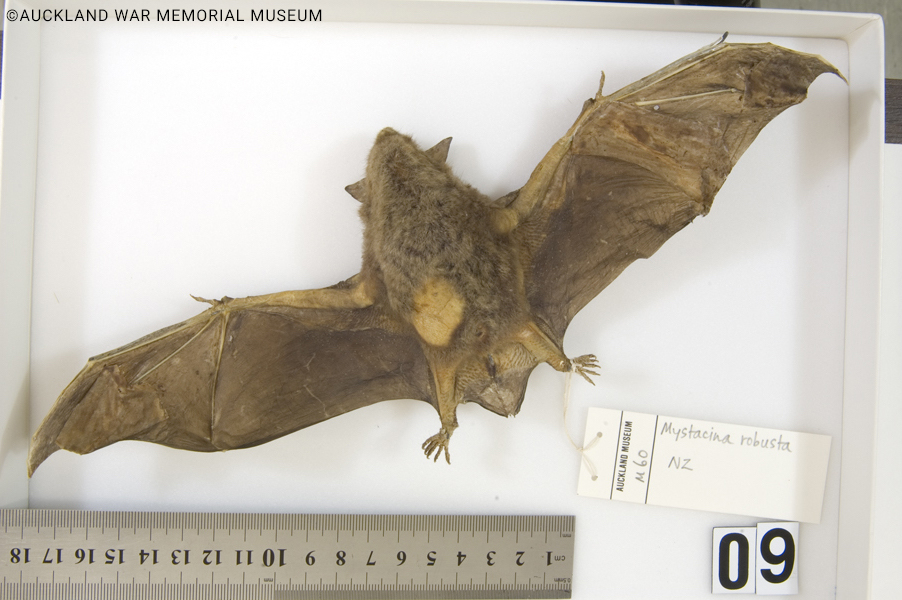
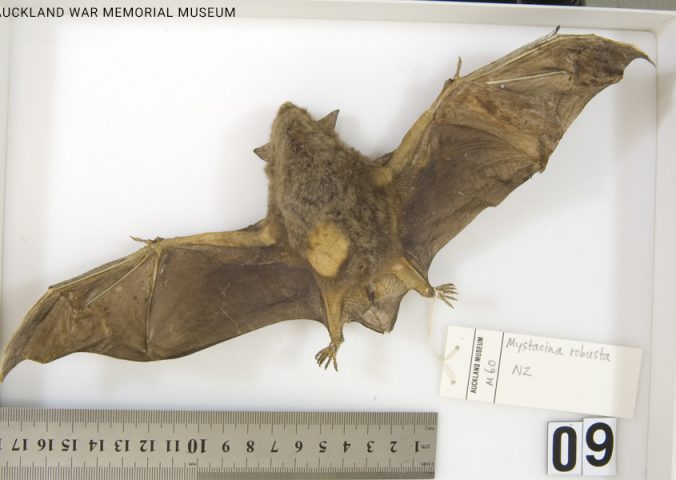
M. robusta had a head-body length of 61-66 mm and weighed between 25 and 35 g. It was otherwise very similar to the surviving, slightly smaller lesser short-tailed bat Mystacina tuberculata ( one of the Top 100 EDGE species ). The thick coat was greyish-brown with paler underparts. The wings could be rolled up beneath a leathery membrane on the side of the body when the bat was not flying, allowing the forearm to be used as a normal forelimb for walking and climbing. Sharp claws, short thick legs, and grooves on the soles of the feet all further allowed the bats to run freely and be remarkably agile on the ground.
This species was found in forests and roosted in hollow trees (probably southern beech, kauri, totara, rimu, rata and kamahi), caves, crevices and seabird burrows. This species may have formed colonies of about 500 individuals or roosted in small groups. It has been suggested that births occurred from spring to autumn and a single offspring was produced in a litter. The diet was surprisingly broad, comprising fruit, nectar, pollen, arthropods, and also fat plucked from muttonbirds (juvenile shearwaters) and scraps of meat left to dry by hunters. They appear to have been convergent to some degree on small rodents, in the absence of similar species in New Zealand's pre-human fauna. Aerial prey was located by echolocation, but short-tailed bats are also well adapted for locating prey on the ground using their acute hearing and possibly also olfaction.
Size variation shown by subfossil material of the greater short-tailed bat shows a clinal pattern, with size decreasing significantly southwards across the North and South Islands. This is believed to represent a trade-off between selection for relatively large body size, to exploit the abundant macro-invertebrates and microvertebrates available on the forest floor, and the increasing cold-limitation of body size towards the south, where more energy was required to rewarm the bats from the near-ambient temperatures reached during torpor.
Greater short-tailed bats were apparently wiped out from the North and South Island mainlands by introduced rats, either the Pacific rat (Rattus exulans) introduced by the first Maori colonists, or black rats (Rattus rattus) and Norway rats (Rattus norvegicus) introduced by European colonists in the late eighteenth century. These rats impacted native bat populations either through predation, competition for food, and/or continual disturbance of roosting sites. These three rat species are also responsible for the extinctions of a large number of other New Zealand endemic species, such as flightless wrens and other ground-nesting birds, lizards and leiopelmatid frogs. Extensive deforestation across much of New Zealand during prehistory and recent history also removed large trees which would have formed important roost sites for this species.
Rats were accidentally introduced to the greater short-tailed bat's last refuge, Big South Cape Island, from a fishing vessel in 1964, but at the time many senior New Zealand scientists refused to believe that introduced mammals could be responsible for eradicating native species in island systems. This scientific resistance led national conservation planners to refuse the translocation of any of the island's threatened native species to other predator-free offshore islands, preventing practical conservation efforts to save these species for several years. By the time a rescue operation was finally permitted, it only proved possible to translocate South Island saddlebacks successfully on the first attempt; the greater short-tailed bat, bush wren and Stewart Island snipe all became extinct before further conservation work was carried out. Greater short-tailed bats were last observed on Big South Cape Island in 1967, and became extinct shortly afterwards.
Gill, B. J. 2002. Records of bats (Mammalia: Chiroptera) from Late Holocene dune-sands at Te Werahi Beach, Northland, New Zealand. Records of the Auckland Museum 39 : 45-47.
Schutt, W, A. Jr and Simmons, N. B. 2005. Quadrupedal bats: form, function and evolution. In Zubaid, A., McCracken, G. F. and Kunz, T. H. (eds) (2005) Functional and evolutionary ecology of bats: 145-159.
Worthy, T.H., Daniel, M.J. and Hill, J.E. 1996. An analysis of skeletal size variation in Mystacina robusta Dwyer, 1962 (Chiroptera: Mystacinidae). New Zealand Journal of Zoology 23 (2) : 99-110.
Worthy, T. H. and Scofield, P. 2004. Skeletal and dental variation within and between Mystacina species in southern New Zealand. New Zealand Journal of Zoology 31 (4) : 351-361