Since its inception the EDGE of Existence programme has been identifying the top EDGE species in a number of taxonomic classes and has begun to focus conservation efforts on selected individual species. But could focusing on areas where multiple EDGE species occur be a more effective way to achieve our conservation goals? Today we are one step closer to achieving just that.
In a paper published today in PLoS ONE, scientists have identified for the first time areas of the world containing the highest concentrations of EDGE species.
Scientists mapped the distribution of the top 5% of EDGE mammals, highlighting regions of the world containing high numbers of exceptionally unique and threatened species, such as the lemurs of Madagascar or Australian marsupials. They then combined this map with one showing regions of the world that contain a higher number of EDGE species than expected by chance. The resulting (combined) map highlights areas of the world – EDGE Zones – where EDGE species are concentrated.
Results show that the most important EDGE zones for mammals are found in South and Central America, Madagascar and Southeast Asia, as well as large parts of Southern and Eastern Africa. When scientists repeated the mapping process for amphibians, they found that different regions were highlighted: the East and West coast of North America, Central America, Southern Europe and Australia with smaller areas elsewhere. The difference may be explained by the biogeographic histories of the two groups, as well as range sizes and the fact that they may be impacted by different threats.
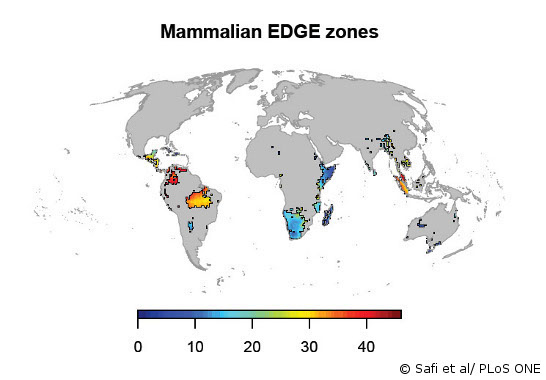
The study, which also mapped the distribution of ED mammals and amphibians, revealed a number of fascinating results. One of the most interesting is the difference between ED and EDGE mammal zones: the most evolutionarily distinct mammals are concentrated in east and southern Africa and South America, reflecting where the most ancient mammal lineages evolved, yet when threat is taken into account, Southeast Asia becomes a much higher priority. The reason for this is that while species in Southeast Asia are less evolutionarily distinct than their counterparts in the Americas and Africa, the threats they face are much greater due to the region’s high human population density.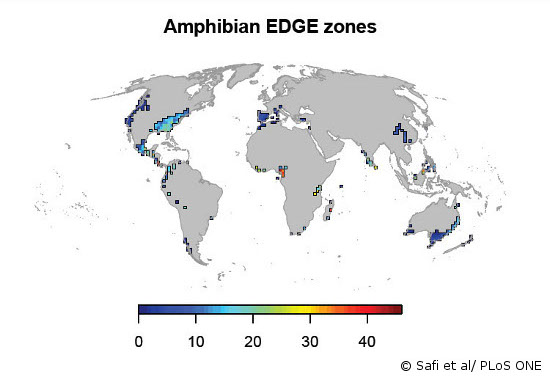 The research highlights just how little of these EDGE zones are currently protected. While 15 per cent of amphibian EDGE zones intersect with protected areas, only five per cent of the mammal EDGE zones are protected. Currently protected areas, like national parks and community-managed nature reserves cover just under 13 per cent of the world’s land surface. In 2010, the world’s governments committed to expanding this to 17 per cent by 2020, with an emphasis on areas of particular importance for nature. We call on governments to recognise the importance of EDGE Zones when creating new protected areas.
To better understand where the EDGE zones are found visit our new interactive EDGE map here.
For more information and explanation of the methodology used read the full paper here.