
My name is Arun Kanagavel and I have been working in the Western Ghats Biodiversity Hotspot in India on herpetofauna and with local communities to integrate them into participatory forest management and conservation. After my Master’s course at the Durrell Institute of Conservation and Ecology, my first break into the field was through the Zoological Society of London’s (ZSL) Erasmus Barlow Expedition to understand the population and threats to the threatened rainforest-dwelling chelonians of the Western Ghats – the Cochin Forest Cane Turtle and Travancore Tortoise. Extremely cryptic, these species were immensely difficult to detect and it took us three months to find our first cane turtle.
Three years later, and it feels really good to be back working with ZSL through the EDGE Fellowship. There has been an immense recent buzz in amphibian research in India due to the efforts of numerous researchers which has resulted in the discovery of numerous amphibian species and improving critical taxonomical aspects. The subsequent outreach beyond the academic community has resulted in improved awareness towards amphibian conservation and has generated an increased interest in watching and documenting them.
 My interest in amphibians is quite recent and definitely as a result of all the work generated by the research community. The Anamalai Gliding Frog (Rhacophorus pseudomalabaricus) and Resplendent Shrubfrog (Raorchestes resplendens) were two species that really caught my attention along with the widely popular Purple Balloon Frog (Nasikabatrachus sahyadrensis) which is fourth on the Top 100 EDGE amphibians list. I was interested in improving the conservation of a lesser known species and there were three other potential species of interest on the EDGE list: Indirana phrynoderma, Indirana gundia and Melanobatrachus indicus. I was keen on improving the conservation of the Toad-skinned Frog Indirana phrynoderma a Critically Endangered species range-restricted to the Anamalai Hills of the Western Ghats which would be “hard to sell” as it lacked favorable aesthetics like in the case of the Anamalai Gliding Frog or Resplendent Shrubfrog. I currently pursue this with support from the EDGE program and as an EDGE fellow aim to improve the existing information available for the species mainly its distribution, abundance, habitat parameters, threats and life cycle. The toad-skinned frog Indirana phrynoderma as a species resembled a lot to the chelonians I had worked with previously by being rare, crepuscular, forest-dwelling and being able to brilliantly camouflage in their environment. The only thing that bothered me a bit other than the research permits (which takes a really, really long time to get!) was how long it would take to find the animal or whether we would.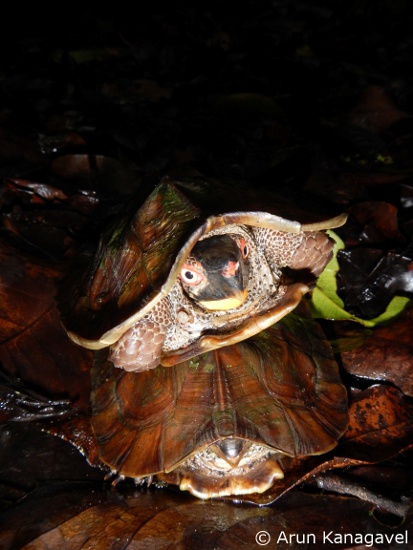
After a record 11 months to get the permits, I set off late May 2013 to search for the species at the Anamalai Tiger Reserve in the south Indian state of Tamil Nadu in the Western Ghats where the species was described from. On the very first day of the trek, I came across a pair of cane turtles mating! Once another species becomes focal, I suppose the previous ones come out in plenty to pull off a good joke! The breeding season for amphibians as well had just begun and a few Indirana semipalamata and their characteristic tadpoles were seen. The tadpoles of the Indirana genus are characteristic in the sense that they do not occupy pools of water but instead are seen on tapering rocks with a slim layer of water and vegetation. It has been two months as of now and the toad-skinned frog has not yet been encountered during the surveys at the Anamalai Tiger Reserve. Hopefully the third month like in the case of chelonians would be a bit more fruitful.