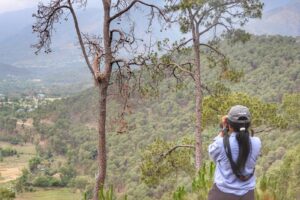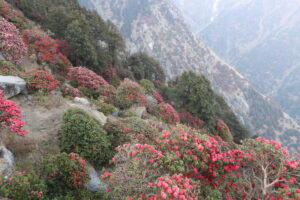
The first time I walked into the high-altitude landscapes of the Himalayas for fieldwork, I felt as if I had entered another world. Snow-capped mountains stood in silence against deep blue skies. Rhododendron forests painted the slopes with red and pink blossoms.
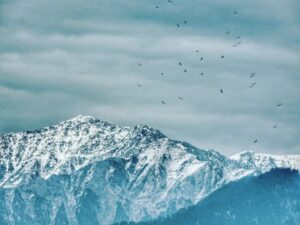
Himalayan Monals flashed metallic colours in the sunlight, like living rainbows. Somewhere among the cliffs, the elusive Snow Leopard moved unseen. These are the scenes and species people travel across the world to see. They capture our imagination almost instantly. But I wasn’t there for the Snow Leopards or the Monals. I was there for the vultures.
Dark silhouettes circling high above the valleys. Their featherless heads, sharp hooked beaks and association with death mean they are rarely admired. In many parts of Himachal Pradesh, vultures are locally known as ‘ill’, a term associated with sickness. Some people avoid even the shadow of a vulture passing overhead. Unlike Snow Leopards or Monals, vultures rarely appear in paintings, tourist brochures or stories celebrating the wildlife of Himachal Pradesh.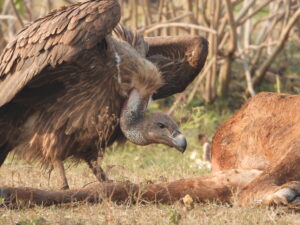
As I embarked on my work years ago studying the breeding ecology of the Critically Endangered White-rumped Vulture in the Himalayas, I found myself asking a simple question again and again: Why do we value some species more than others?
The first time I saw a White-rumped Vulture was a moment I will never forget. I never imagined that I would encounter a Critically Endangered species from such close quarters at Pong Dam. As the bird spread its enormous wings, its striking white rump stood out against the dark plumage, creating a sight that was both powerful and beautiful.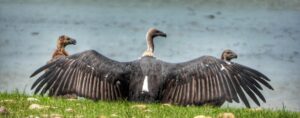
Before that day, hornbills had always been my favourite birds. Their vibrant colours and remarkable bills had fascinated me for years. But vultures were different. Their beauty was not loud or obvious. It revealed itself slowly, the more I observed them. Looking closely, I noticed their long eyelashes, almost human in appearance, framing eyes that seemed full of curiosity and quiet expression. There was an intelligence and depth in their gaze that I had never experienced with any other bird.
Learning to see differently
At first, I saw the vultures much as other people do. They really do challenge everything humans typically associate with beauty. They gather around carcasses and feed on the dead. They do not sing like songbirds or dance like cranes. But spending months watching them changed my perspective.
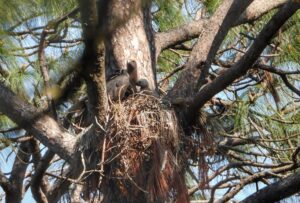
I saw breeding pairs faithfully return to the same nesting trees year after year. I saw parents shelter their chicks against the harsh Himalayan weather. I sat beneath the Chirpine forests for months and began to see both the essential role these birds play in cleaning the ecosystem and also the fragility of these colonies in the face of logging, fires, and habitat disturbance.
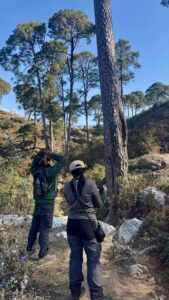
Fieldwork often began at 7 a.m., sitting and writing notes on nest observations with my field assistant, Manoj Kumar, who is a local from Himachal, sitting quietly beneath a Chir Pine tree, watching a single nest for nearly five hours. Some days were filled with excitement, while others seemed to pass in complete stillness. In the scorching summer heat, the hours felt endless, whereas winter mornings were far more pleasant. During the quieter moments, I often turned my binoculars to other birds, recording eBird checklists and appreciating the incredible diversity around me.
One of the most fascinating sights was watching Large-billed Crows seize every opportunity to steal food from the nest whenever the parent vultures were away. Their intelligence and timing were remarkable.
The nest itself, however, was always the centre of my world. Yet nothing compared to witnessing the growth of a new life. Watching the adults carefully incubate a single egg, waiting patiently for weeks, and finally seeing a tiny, fluffy white White-rumped Vulture chick emerge was an experience beyond words. Seeing that fragile chick gradually grow under the watchful care of its parents remains one of the greatest privileges of my life.
Gradually, I stopped seeing vultures as ugly birds and began to see them as remarkable survivors among the most misunderstood creatures on Earth.
.
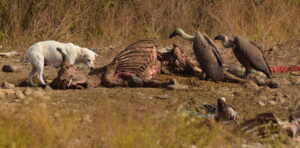
Their appearance reflects the job that evolution has bestowed on them. Their powerful digestive systems allow them to consume carcasses carrying pathogens that would be dangerous to most other animals. By rapidly removing dead livestock and wildlife, vultures help reduce the spread of disease across landscapes shared by people, livestock, and wildlife. It is difficult to imagine a more important public health service provided entirely by nature.
When we lose overlooked species
India has already experienced what happens when vultures disappear. During the 1990s and early 2000s, populations crashed across South Asia after vultures consumed livestock treated with the veterinary drug diclofenac. Within little more than a decade, millions of birds were lost. The consequences reached far beyond the vultures themselves. Carcasses remained in the environment longer, feral dog populations increased, and human exposure to rabies rose. The loss of nature’s most efficient cleanup crew had significant implications for both ecosystems and human health. The crisis revealed something important: species we rarely notice (or dislike) can be among the most valuable.
Changing minds, not just protecting birds
Some of my most memorable moments in conservation haven’t happened while collecting field data. They have happened during conversations with people living alongside vultures. Many people I met initially viewed vultures with suspicion or disgust.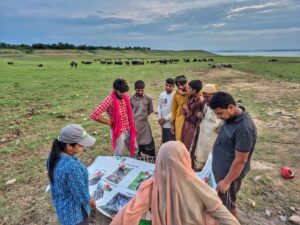
One of the moments that has stayed with me happened during a visit to a village. I was wearing a T-shirt with a White-rumped Vulture printed on it when an elderly grandmother looked at me with concern. She told me that vultures were “dain” or witches, symbols of something evil, and asked why I would wear such a bird on my clothes. She even suggested that I should change into something else. That conversation made me realize how deeply rooted myths and misconceptions about vultures still are. For generations, these birds have often been associated with death, bad luck, or evil simply because they feed on carcasses.
Children, too, often have a very different image of vultures. Many believe they are giant birds that can carry people away or attack humans. Some even think vultures hunt and kill people.
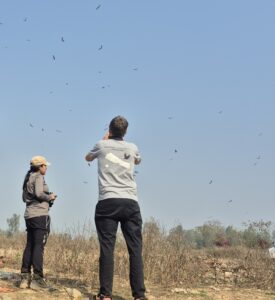
In reality, nothing could be further from the truth. Vultures are gentle scavengers. They do not hunt humans or livestock. But when we talked about the role these birds play in preventing disease, the conversations often changed. Curiosity replaced indifference. Concern replaced misunderstanding. One of my favourite moments was watching local children look at vultures through binoculars for the first time. Instead of something frightening, they began to see magnificent birds soaring above the mountains. Those experiences reminded me that conservation isn’t only about protecting wildlife. It’s also about building understanding.
What the EDGE Fellowship changed
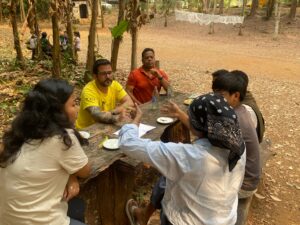
The EDGE Fellowship helped me see conservation through a wider lens. During the Conservation Tools Course in Thailand, I learned approaches for working alongside communities, listening to different perspectives and designing conservation projects that place people at the centre rather than treating them as an afterthought. The Fellowship reinforced that lasting conservation depends as much on trust and relationships as it does on ecological knowledge.
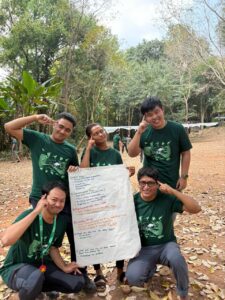
Those lessons have shaped the way I now approach my work in Himachal Pradesh. Through the EDGE Fellowship, I began using participatory conservation approaches and stakeholder or actor mapping to understand the complex relationships between people and vultures. Instead of viewing local communities as beneficiaries of conservation, I started involving them as partners in the process. Each group has a different influence on the availability of safe food, nesting habitats, and the long-term survival of vultures
Alongside monitoring vultures, I think much more carefully about how conservation messages are communicated, whose voices are included and how local communities can become partners in protecting these remarkable birds.
A different kind of beauty
One evening during fieldwork in Kangra, I stood beneath a nesting colony as dozens of White-rumped Vultures returned to roost. The setting sun lit the surrounding mountains in orange, while the birds circled silently overhead before settling into the pine trees. For a long time, I simply watched.
As I watched them soar effortlessly above me, against the endless Chir Pine forests with the mighty Dhauladhar mountains in the background, I often wondered what their future held. They flew with complete freedom, unaware that the forests they called home face threats from logging, forest fires, and expanding development. Did they worry about the future? Whether their nesting trees would still be their next season, or were they simply focused on finding enough safe food each day to feed their growing chicks?
I realised they are beautiful from within, not because they had changed, but because I had. Conservation has taught me that beauty isn’t what makes a species valuable. Every species has a role to play, whether it appears on postcards or spends its life quietly cleaning our landscapes. Perhaps one of conservation’s greatest challenges isn’t persuading people to love every species equally. It’s helping people understand that every species matters. If we can change how people see vultures, perhaps we can also change how we think about the natural world itself.