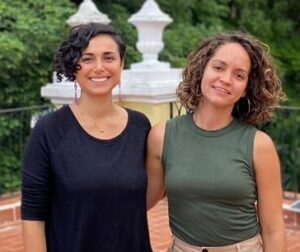
What happens when two conservationists from different countries discover they’ve been asking the same questions?
This joint blog traces how their shared experiences with amphibians, women’s voices, and community engagement sparked new ways to connect people with nature.
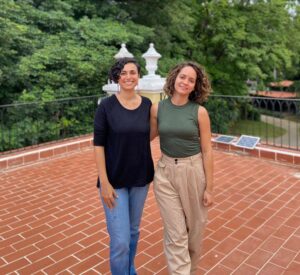
Carolina Mildred Rivera González, Mexican EDGE Alumna from the 2021 EDGE Fellowship cohort
It all began as a simple idea to connect a socio-environmental project in my area of study. In 2021, while developing my EDGE Fellowship project on endemic salamanders in Cuetzalan, Puebla, I wanted to design environmental education activities that genuinely reflected who I was. I knew from the start that engaging local communities would be essential, but I wasn’t sure which activities could create meaningful outreach.

.
Like many things in life, the answer arrived unexpectedly. During a one-hour walk to a sampling site in a community called Tacopizacta, a nice woman approached our team and asked if she could go down to the community with us, just to be accompanied. An idea immediately sparked. I saw that moment as an opportunity to ask her questions about her perception of the local environment, the animals she lived alongside and what daily life looked like for her and her community.
Throughout the walk, the four of us were captivated by everything she shared. Her understanding of the cloud forest and the amphibians, the subjects that most interested us, was unlike anything we had encountered before. She spoke with a deep sense of connection to her surroundings. The walk went very quickly, and the experience stayed with us. We wanted to learn more, so we asked if we could return to speak with more members of her family and she invited us to her home the next day.
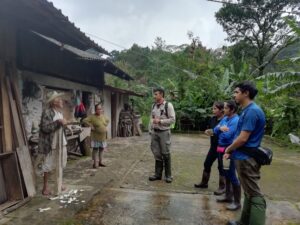 The following day, we arrived and were greeted warmly, and had the chance to speak with several relatives. However, we noticed something interesting. Our travelling companion had changed the way she expressed herself. She was quieter, more reserved, and more focused on housework. When we asked about what she had told us the day before, her answers were brief. At that moment, I was grateful to have met her on the road and that we hadn’t missed out on such an honest and valuable conversation. I remember talking with my teammates, and we found the change curious, but we concluded that she may not have felt comfortable expressing herself in front of other family members.
In many parts of Mexico, especially in small rural communities, it is still very common for men to be the head of the house, the person in charge of speaking publicly and expressing opinions, while women take on other roles, mainly caring and feeding, with limited participation in other activities.
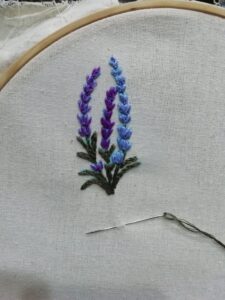 The insights we gained from our travelling companion were invaluable and led us to organise an activity specifically designed to meet local women, learn from them, and not miss out on all they could share with us. It had to be something that would give them a safe and welcoming place to express themselves. While I generally believe activities should be open to all, in this case, I wanted to find something that would primarily attract women to a space where they would feel comfortable. This meant finding something men were likely to pass up. I remembered at that moment something I enjoyed very much with my grandmothers and that undoubtedly, at least in my country, very few men did: embroidery.
That is how A-bordando Anfibios was born: a play on the Spanish words abordar, which means to approach someone and bordar, the verb to embroider. The idea was to use fabric and threads to connect with women, get to know them, hear their ideas and perceptions, and spend time together away from home and daily chores.
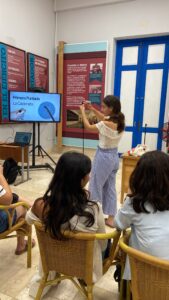
Unfortunately, we weren’t able to run the activity in the community at that time for logistical reasons, but I carried the idea with me. Two years later, a pilot project of A-bordando anfibios was carried out with a group of women within a totally different context in Havana, Cuba, while I was living there.
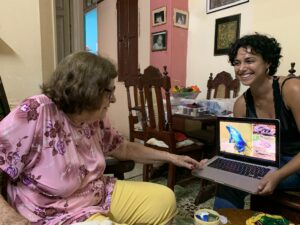
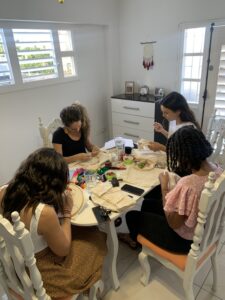
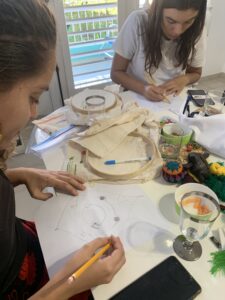
The experience was personally very satisfying, with a lot of feedback and diversity of opinions and beliefs. We talked about amphibians, what they thought about them, the environment, and we created together. The embroidery pieces may not have been masterpieces, but the time spent stitching side by side is something I will always treasure.
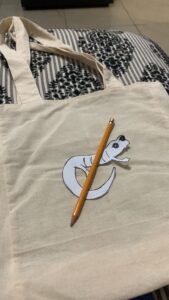
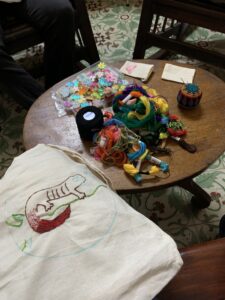
From that experience, I connected with someone who shared my ideas. Mariam Curbelo Cruz, who, by chance, lived a few blocks from me in Cuba and also worked on amphibians, was selected for the 2024 EDGE Fellowship cohort.
Mariam Curbelo Cruz, current Cuban EDGE Fellow from the 2024 EDGE Fellowship cohort
And so, just as spontaneously as everything else in this journey, Carolina and I met, under the characteristic spring heat of Havana. Two Fellows from different cohorts and contexts, yet connected by the same love for conservation and conversation. The stories Carolina shares here, along with others told over coffee and long talks, left a deep impression on me. It was through talking to her that I realised something, in all the workshops we had held in the community where my project takes place, only one woman had participated, because in our region, most people working in protected areas are men.
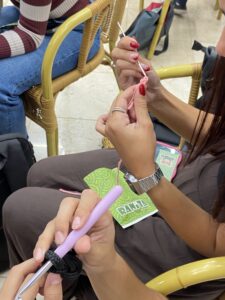
 The intricate weave of life also led me to meet Karen, an undergrad biology student who has been deeply committed to the project. Her grandmother taught her to crochet when she was a little girl; it was the missing ingredient. Inspired by Carolina, we created Tejiendo y Conservando (Crocheting and Conserving), a workshop open to the whole community but focused on women. These kinds of initiatives tend to emerge naturally. For generations, women have gathered to talk, but our restless minds or the burden of constant responsibilities rarely let us focus on just one thing at a time. Embroidery, knitting, sewing, these crafts have always been faithful companions to our busy hands, an excuse to sit together, chat and let things out.
Across three different sessions, Karen and I worked with groups of girls and women from two communities. The goal was simple: to talk about amphibians and our conservation project, while teaching them how to crochet a little frog. But before we could teach anyone else, Karen first had to teach me. Our sixteen-hour bus journey was enough to show us how challenging it can be to teach a hands-on skill. Still, she managed to teach me, with far more patience than expected.
We started with the upstream settlement to test the idea. The women there belong to a family that has welcomed us on every expedition, so we felt it was a comfortable place to learn how to teach. That first pilot workshop lasted three hours, which was too long, so we decided to split the activity into two sessions next time.
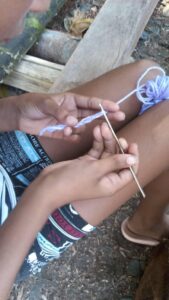

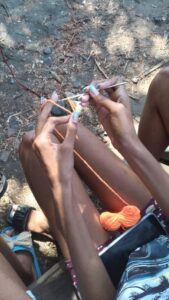
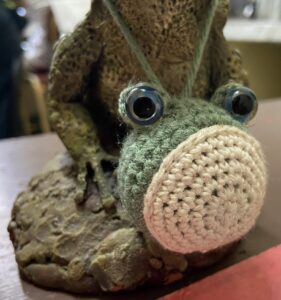 Walking downstream to the town, together with the cultural promoter, we organised the second workshop by the river. About ten girls of different ages joined us. We split into two groups and, surrounded by laughter and little frogs, we made it through part one, making crochet chains. We followed Carolina’s model: with each stitch or new technique, we paused to discuss the amphibians, their ecological role, what the girls thought about them, and what they had heard in their homes. We learned that people often confuse the sound of our EDGE frog’s call with that of a cricket, that some women fear frogs, but far less than stereotypes suggest, and that very little is known about the region’s frog diversity. The stories recalled almost always gave the spotlight to another species, the Cuban Tree Frog.
On the second day, we held the second part of the workshop. Word had spread, and we ended up with twenty women. Attendance was so good that Karen had to donate her own needles because we didn’t have enough, and it was impossible to turn anyone away. This session was a bit more chaotic, so we split into beginners and those continuing from the day before. I think that, more than talking about amphibians, it allowed us to get to know many of the women in the community, and for them to get to see us not just as those strange outsiders with muddy boots and worn-out faces wandering around for fifteen days.
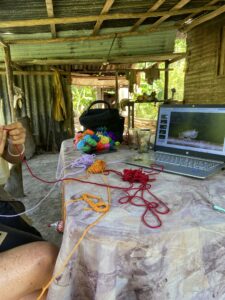
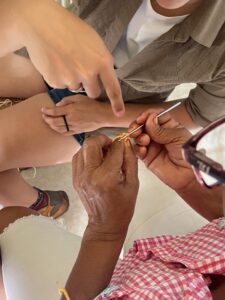
Workshops like these can shift the way we do conservation, making it more dynamic and leaving behind not just words, but a practical skill. We know that most of the twenty women won’t become weavers, but the experience will stay with them. Those shared moments, the stories exchanged, the small connections built stitch by stitch, they stay with us too. Sometimes we tend to forget that conservation is not only about monitoring a species and studying their natural history; it’s also about understanding the people who live alongside them and who will have the opportunity to protect them every day. And sometimes, the best way to get to know them is one stitch at a time.
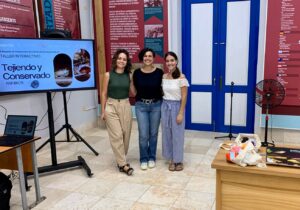
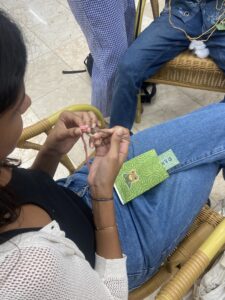
Co-written by two EDGE Fellows, whose projects unexpectedly intertwined, we hope you enjoyed this blog that explores how conversation, craft and community can reshape how we approach conservation.
Carolina Mildred Rivera González
2021 EDGE Alumna
Mariam Curbelo Cruz
2024 EDGE Fellow