This week, here at the EDGE Conservation Tools training course we’ve been focusing our attention on Red Listing and action planning.
As many of the participants are working on EDGE species that aren’t well-known to the scientific community, it’s crucial that the participants understand these processes and how their work can contribute to the wider conservation of their focal species.
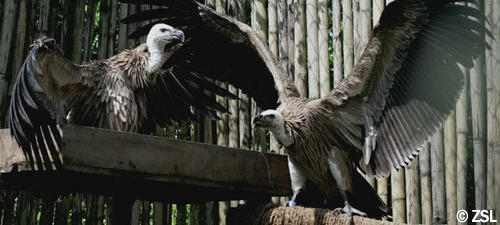
Because it’s a regionally relevant issue, as part of this module we chose to look closely at the Vulture Conservation Action Plan for Nepal. Within Nepal, India and Pakistan, vultures have undergone a dramatic decline since the mid 1990s. It’s estimated that in excess of 97% of the three resident species have been lost. The main, potentially only, reason for this loss is the veterinary use of diclofenic (a non-steriodal anti-inflammatory). Vultures feeding on carcasses that have been treated with diclofenic die from diclofenic-induced kidney failure. The action plan was written in 2008 and some of the course participants (and the staff at NTNC) contributed to it.
To see some of this action plan ‘in action’, we visited the vulture breeding centre situated at Chitwan National Park Headquarters. It’s not possible to see the vultures directly, as they’re very sensitive to disturbances, but via CCTV cameras positioned in their enclosures we were able to see the healthy population of Gyps vulture that is held at the centre. Ultimately, once the non-human use of diclofenic has been entirely eradicated, it is hoped that this captive group can be used to help repopulate the wild population.
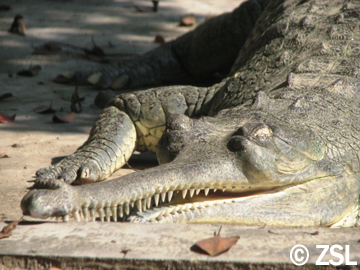 Chitwan National Park Headquarters also houses a gharial breeding centre which, as you might hope, was absolutely bursting with gharials of all sizes! As well as being an important education tool, these gharials are part of a reintroduction programme and they will be grown in captivity for two to three years before being released to aid recovery of the Critically Endangered wild population (and to be counted during boats surveys by future EDGE course participants!)
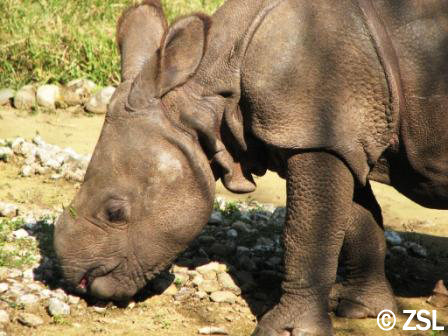
Three infant Greater-one horned rhinos, that were orphaned and have been hand-raised by Chitwan National Park staff, also call the park’s headquarters their home and during our visit we we’re lucky enough to meet them (and they were very grateful for the bananas we had to offer!).
Vultures, gharials and rhinos (and a lesser adjutant on the way to the breeding centres) – some of Nepal’s most endangered wildlife, all in a day. Amazing!
… and you will be not only be supporting the conservation of extraordinary species, but also the development of future conservation leaders.