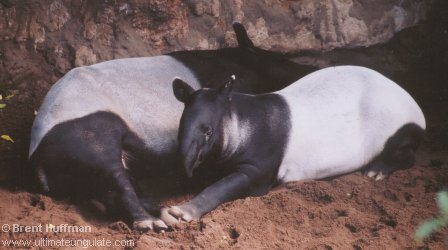
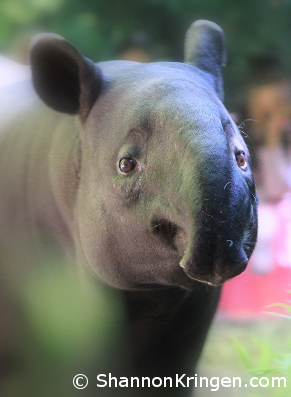
 A unique distinctive feature of tapirs is their short gripping trunk, which truly is an extended prehensile nose and upper lip. It allows a tapir to grab leaves from twigs, have an incredible sense of smell and even use it as a snorkel while swimming. This fleshy prehensile trunk has changed little in millions of years of evolution. The Asian Tapir also known as Malayan tapir is an important seed disperser in the rainforests and lower montane forests where it lives. Predominantly active at night and shy, this animal seeks refuge from human encroachment in forest interiors and is rarely seen.
The Asian tapir is the largest of the four tapir species; it can grow to 1.8 meters and weight 363 kilograms. It is also the most evolutionarily distinct of the four living species of tapir and the only one surviving in the Old World. Unlike its relatives in the Americas, it has a distinctive white band on its back and sides which might help break the silhouette of the animal in the dim forest light protecting it from predators. Infants however, are born with a reddish-brown coat covered in white stripes and spots, but as they grow their coat changes.
Fragmented populations of Asian tapirs occur throughout Southeast Asia, from southern and central parts of Sumatra to Malaysia, southwest Thailand, and southern Myanmar. Asian tapir populations however have declined more than 50% in the past 36 years due mainly to habitat loss. The species range has particularly suffered from forest being converted to palm oil plantations. Additionally, hunting, a relatively minor threat in the past, is becoming a bigger concern. As the number of commonly hunted species declines, hunters have turned their attention to this tapir.