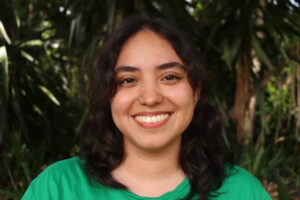
My name is Susana Sánchez, a biologist who recently graduated with a master’s degree and a lifelong love for the mountains of north-eastern Mexico. My work focuses on conserving and studying Pinus culminicola (locally known as “pino piñonero enano”), a small and rare pine that survives only on the region’s highest peaks, where few other trees can survive. It is one of the few tree species adapted to survive in such extreme mountain conditions, yet today it faces serious threats from climate change, recurrent wildfires, and the reduction of its natural habitat. I have always considered these mountains one of my favourite places in the world, and I felt a deep connection with this species that seems to embody their resilience. What began as a scientific challenge, full of fieldwork, data collection, and long treks through rugged terrain, has become something far more meaningful: a deeply human experience.

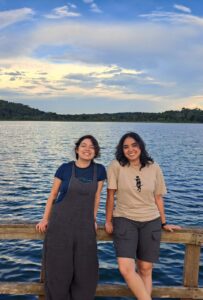
I think that many young researchers start their training believing that science happens mainly in modern laboratories, universities, or research centres. I was no exception. My previous experience had been developed in that academic environment, so I felt comfortable with data analysis and technical work. However, something changed during the training course for the EDGE Fellowship. There, I met Ilse, an incredible colleague who shared how she worked directly with people from rural communities, and how their stories, knowledge, and perspectives deeply enriched her research. Her approach surprised me and made me question: can talking to people really bring something important to my project? That question stayed in my mind, and her anecdotes sparked a new curiosity in me: what can local people tell me about these mountains that I haven’t read in books or scientific articles?
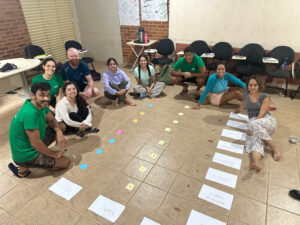
During the course, we also learned about how social sciences can be applied to conservation; this part was especially inspiring for me. I had never truly paused to consider the importance of the human and cultural perspectives within scientific projects. Hearing real examples of how to integrate these elements motivated me to take this dimension of research much more seriously. I began to imagine a project where science would not only speak through data, but also through the voices of the people who live in contact with the species we study. In my case, that means the forests.
At the same time, that idea generated great insecurity in me. I didn’t know how to approach or start conversations with people outside of academia. I felt anxious at the possibility of not knowing how to communicate, of not finding the right words, of not connecting. It was then that having the support of my friend and classmate in the master’s degree, Mayte, became key. From the very beginning of the project, she has accompanied me to meetings, helped me plan presentations and, most importantly, encouraged me to step out of my comfort zone. Thanks to her, and to what I learned from Ilse, little by little I began to open up to the human dimension of the project and to discover that science, too, is built with relationships and listening.
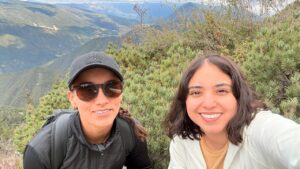
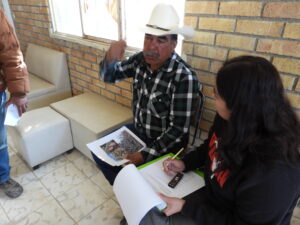
As a first step, we reached out to anyone who might be able to support us, old friends, NGOs, and government institutions. Initially, I had the misconception that we were on our own, but I soon discovered that there are far more people willing to collaborate than I had imagined. That’s how we arrived at the local office of the National Commission of Protected Areas (CONANP), which manages one of the most important natural protected areas for our project. There, we met Felipe Ruiz and Carlos Hernández, the managers responsible for this area, who immediately showed great interest in our work and began guiding us by introducing us to local communities, taking us to previously unexplored sites, and suggesting new ways to strengthen the project.
We quickly began to connect with people in rural communities that are nestled deep within the mountain canyons, close to our species’ natural populations. Building relationships with these communities has undoubtedly been one of the most significant parts of the project. Each visit, each conversation, each shared activity together has been marked by a warmth that’s difficult to describe. On more than one occasion, even if our visit was brief or focused on technical work, people offered us food, coffee, and genuine smiles of welcome. That simple hospitality is a powerful reminder that conservation is built on respect and human connection. Science alone is not enough; protecting nature requires collaboration, local knowledge, and a shared commitment.
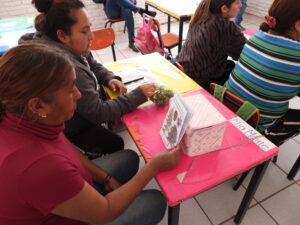
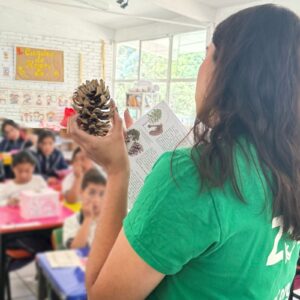

Of course, not everything has been easy. We have faced challenges, doubts, and moments that pushed us to rethink our approach. Working closely with communities has taught me to communicate differently, to listen more, judge less, and approach with humility. Conservation isn’t just about bringing knowledge; it’s about learning from the people who live closest to the land. Often, we believe we are the ones driving a great change, the bearers of knowledge and truth. However, this experience has taught me to pause, listen, and recognise that conservation is also built on the perspectives, voices, knowledge, and wisdom of people.
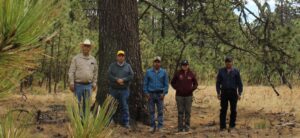
Through this journey, I have realised that a conservationist can be anyone: a woman who joins a reforestation group, men who form a local patrol, or a neighbour who grows seedlings at home. I have also learned that science must be communicated in ways that everyone can understand, because only then can it truly make a difference. Ultimately, conservation is not the work of a single person or institution; it needs a community built on shared knowledge, mutual respect, and the collective commitment of both local people and scientists.
As I approach the end of my Fellowship, I can look back and see what an opportunity it has been to be selected as an EDGE Fellow, precisely because of these new experiences and the space provided for personal growth. I have gained colleagues, friends, and, above all, a deep awareness that science is strengthened by the participation of communities. Today, I know that conserving a forest is not only about protecting trees but also about nurturing and strengthening the human networks that give them life. In the end, what unites science and communities is the hope of a shared future.
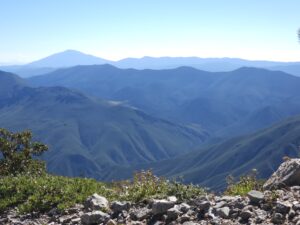
‘A forest lives not by trees alone, but by the hands and hearts that care for it.’
María Susana Sánchez Chávez
2024 EDGE Fellow