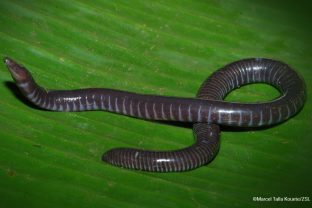
TOP EDGE Amphibians
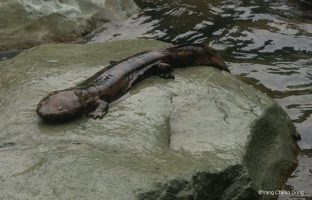
Chinese Giant Salamander
Andrias davidianus
The Chinese giant salamander is the world’s largest amphibian, growing up to 1.8 metres long, with a large tail comprising almost 60% of the body length.
Conservation Attention
Good
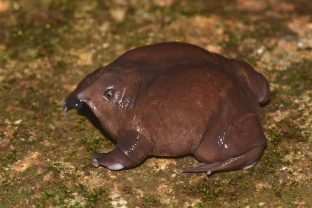
Purple Frog
Nasikabatrachus sahyadrensis
The purple frog (or pig-nosed frog) spends much of its life underground, emerging briefly for a few days each year at the start of the monsoons to breed.
Conservation Attention
Low
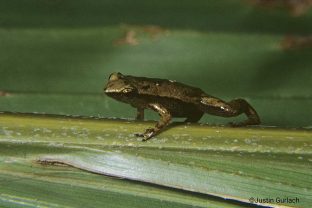
Seychelles Palm Frog
Sechellophryne pipilodryas
The Critically Endangered Seychelles palm frog was only described as a new species in 2002, and details of its breeding behaviour are currently unknown.
Conservation Attention
Very Low
Thomasset’s Seychelles Frog
Sooglossus thomasseti
Thomasset’s frog is the largest of the Seychelles’ native frogs, reaching a maximum length of 55 mm, and is Critically Endangered.
Conservation Attention
Low
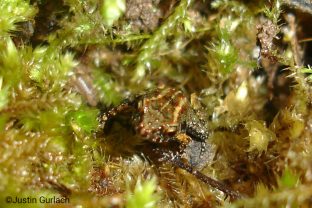
Northern Darwin’s Frog
Rhinoderma rufum
The Northern Darwin’s frog is one of only two frogs in the world which exhibit ‘mouth brooding’ parental care, whereby the young undergo part of their development in the parent’s mouth. It is possible this species is now extinct.
Conservation Attention
Very Low
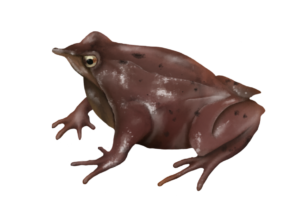
Togo Slippery Frog
Conraua derooi
Reaching moderate sizes of 75-85 mm, it is not immediately obvious that the Togo slippery frog is a close relative of the world’s largest frog, the Goliath frog.
Conservation Attention
Low
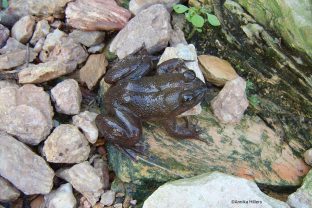
Toad-skinned Frog
Walkerana phrynoderma
The Critically Endangered toad-skinned frog is endemic to the Western Ghats of India. The family of frogs to which this species belongs diverged from all other amphibians over 80 million years ago.
Conservation Attention
Low
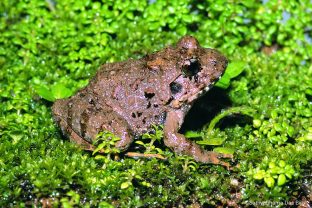
Du Toit’s Torrent Frog
Arthroleptides dutoiti
There have been numerous surveys to locate Du Toit’s torrent frog since its last record in 1962, but all attempts have failed to find the species.
Conservation Attention
Very Low
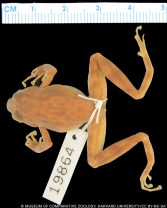
Gardiner’s Seychelles Frog
Sechellophryne gardineri
Gardiner’s Seychelles frog is one of the world’s smallest frog species, with adults reaching the size of just 1 cm! This species is ground-dwelling and forages at night for small invertebrates such as mites.
Conservation Attention
Very Low
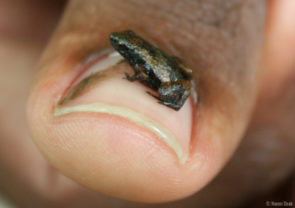
Seychelles Frog
Sooglossus sechellensis
The Seychelles frog is an incredibly tiny frog, with males reaching a maximum length of just 15 mm.
Conservation Attention
Very Low
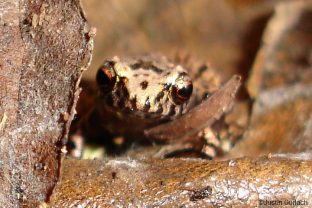
Madagascar Frog
Mantidactylus pauliani
The Critically Endangered Madagascar frog was described in 1974, but was not recorded again for over 40 years until 2010.
Conservation Attention
Very Low
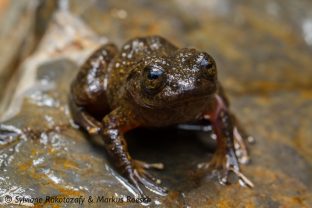
Kottigehar Dancing Frog
Micrixalus kottigeharensis
The Kottigehar Bush Frog is only known from the type locality; Kottigehar, Kadur and from a recently discovered population at Bhadrea, India
Conservation Attention
Very Low
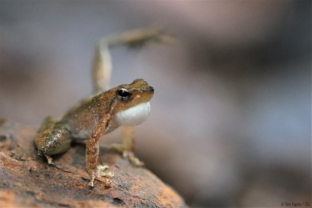
El Rincon Stream Frog
Pleurodema somuncurense
The Critically Endangered El Rincon stream frog exists on a single plateau in Argentinian Patagonia. Though temperatures in the region often plummet below freezing, the frog avoids the cold by spending its life in streams whose waters are heated by permanent thermal springs.
Conservation Attention
Low
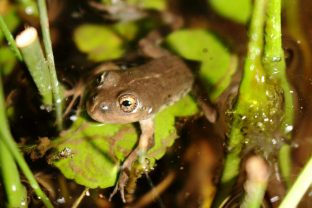
Botsford’s Leaf-litter Frog
Leptobrachella botsfordi
Botsford’s leaf-litter frog was only described by science in 2013.
Conservation Attention
Medium
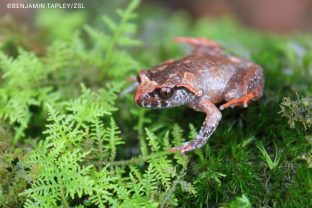
Mistbelt Moss Frog
Anhydrophryne ngongoniensis
The mistbelt moss frog, also known as the mistbelt chirping frog, reaches lengths of just 2 cm. This may be the reason why this species was only discovered in 1993, alongside its faint call, making it difficult to detect.
Conservation Attention
Low
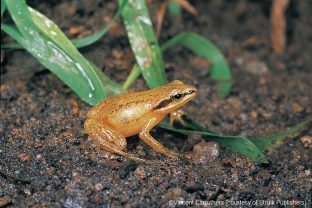
Hewitt’s Ghost Frog
Heleophryne hewitti
Hewitt’s ghost frog is an attractively patterned frog that lives in fast flowing mountain streams and rivers. The tadpoles of this species develop very slowly, taking up to two years to complete their metamorphosis into the adult form.
Conservation Attention
Low
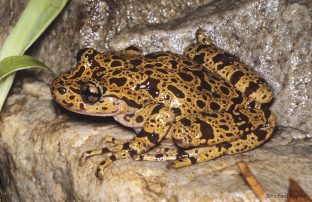
Olm
Proteus anguinus
The olm is Europe’s only cave-dwelling vertebrate, and has numerous unique adaptations for an underground life. Incredibly, the olm can survive without food for up to a decade!
Conservation Attention
Low
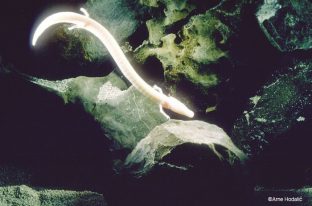
Granular Salamander
Ambystoma granulosum
The granular salamander, unlike many of its close relatives, is a fully metamorphosing species of mole salamander. It therefore develops into an adult form, losing its larval characteristics such as gills and fins, and developing adult traits such as eyelids and functioning lungs.
Conservation Attention
Low
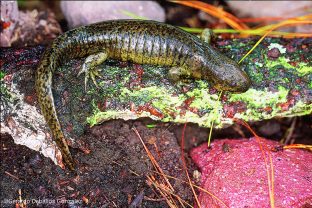
Taylor’s Salamander
Ambystoma taylori
Taylor’s salamander exhibits some incredible features, such as being able to live in salt waters with such high salinity that it would kill most other amphibian species!
Conservation Attention
Low
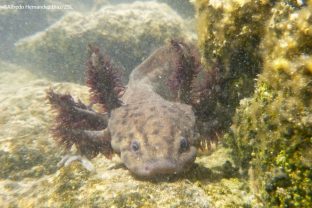
Sagalla Caecilian
Boulengerula niedeni
The Endangered Sagalla caecilian is found on Sagalla Hill, Kenya, with a total range which is equivalent to the area half the size of Manhattan Island.
Conservation Attention
Medium
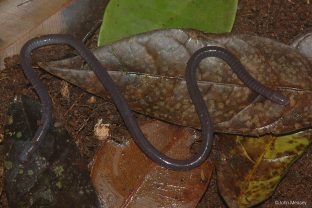
Lake Oku clawed frog
Xenopus longipes
The Lake Oku clawed frog is a small amphibian reaching just 36mm in length. This diminutive species is one of only two frogs known to be ‘dodecaploid’, meaning they have a staggering 12 sets of chromosomes – humans have just two!
Conservation Attention
Good
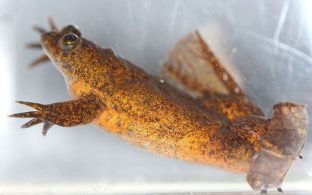
Sardinian Brook Salamander
Euproctus platycephalus
The Sardinian brook salamander is endemic to Sardinia, Italy, and is often found living in cave systems.
Conservation Attention
Low
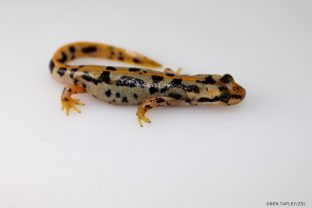
Lake Lerma Salamander
Ambystoma lermaense
The Lake Lerma salamander is a large species of lungless salamander, reaching almost a quarter of a metre long!
Conservation Attention
Low
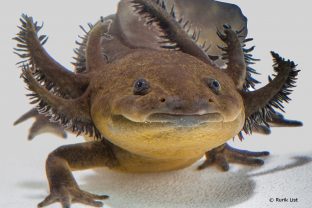
Victoria caecilian
Herpele multiplicata
The Victoria caecilian is only known from one individual, collected in 1912, and it has not been seen since! This has led to fears that this species may have become extinct, and its taxonomic validity has also been put into question.
Conservation Attention
Very Low